
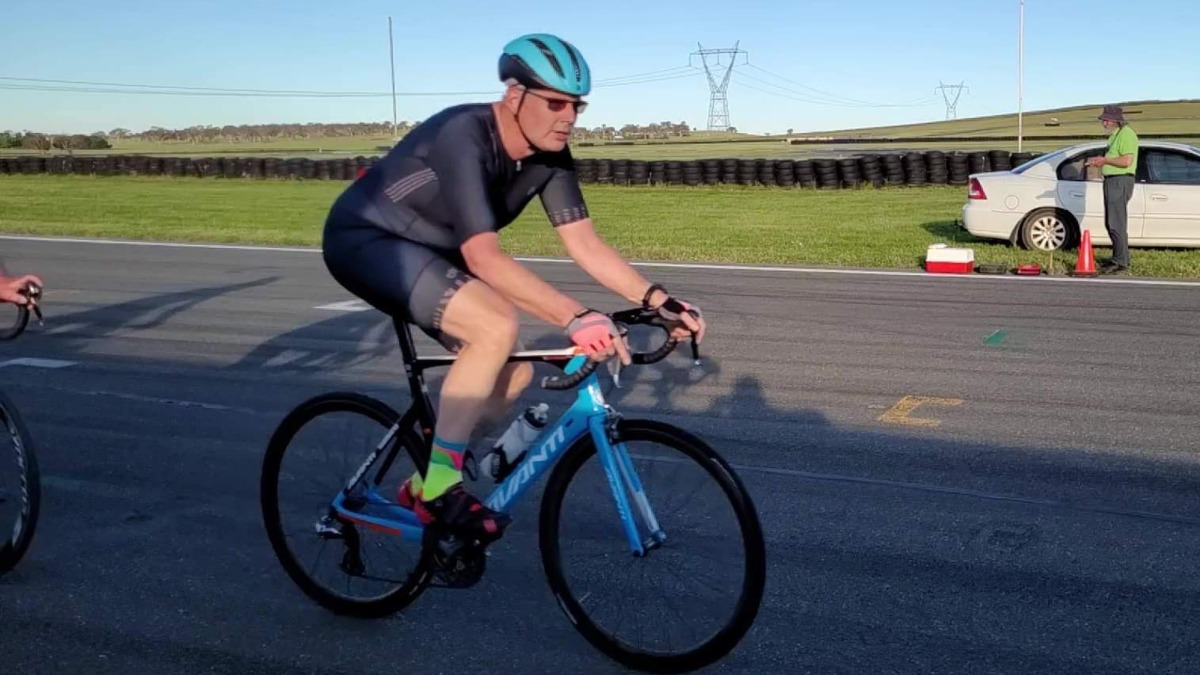
Ian was racing at Wakefield Park in Goulburn when he crashed at 50km/h.
18 August 2022
Last year, 219 people were admitted to Canberra Hospital with a moderate to severe brain injury as the result of a traumatic injury, such as a car accident or fall.
Around 1 in 45 people live with a brain injury and about 2.3% of the ACT population have an Acquired Brain Injury (ABI).
Behind these statistics are the stories of people like Ian, whose life changed in October last year as the result of a cycling accident. Ian’s wife, Mandy, told us about that day.
‘There wasn’t much of him that wasn’t broken… Ian was racing on his pushbike at Wakefield Park in Goulburn. He came off his bike at 50km/h. He was unconscious and unresponsive, and it spiralled down from there.’
‘We’re grateful the team was able to fly to Goulburn and do what they needed to do to stabilise him and get him in the air to Canberra.’
Once at Canberra Hospital, Ian was diagnosed with a fracture in his neck, three pelvis fractures, broken ribs, shoulder and collarbone, and most critically, a diffuse axonal brain injury.
Diffuse axonal injury is one of the worst ones you can have. Ian has had to re-learn how to do everything, including walking, talking and eating.
Ian spent around 10 days in our ICU and then another month in our neurological ward, where he was managed by our Trauma Service, a multidisciplinary team of doctors, nurses and allied health professionals.
‘The Trauma team were fabulous, I can’t rate them highly enough… I can’t fault them in any way at all.’
Ian is now back at home and has made good progress.
‘His speech is good now and he’s doing well with his walking; we call it the ‘old man shuffle’ – he hasn’t got full strides back yet.’
‘He hasn’t been able to return to work which is extremely frustrating for him... He was an active man who loved his job and used to support his family. All of a sudden that stopped. It’s very confronting and it makes you judge your worth, you know, ‘why did I survive this?
‘Even in our personal lives, friends don’t come to see us now because of Ian’s brain injury… they’re cautious about what to expect, so they stay away because they think that’s easier, but they don’t realise how much that affects us. You need support, that’s what gets you through it all. The Trauma Team gave me all the support under the sun when I was sitting beside Ian wishing for things to be different.
‘Ian says he feels frustrated that people treat him differently because of his brain injury and that the constant reminders are difficult: “Don’t harp on about it. Treat me like a normal person. Treat me like a human being”.’
Lainie Hart, Eleni Pavlidou, Christina Donelly and Maia Zucco are from our neuropsychology team. They assess people’s cognitive functions to get a picture of which areas of the brain are reduced because of the brain injury, and which areas look unchanged. We spoke to Christina who told us about brain injury and the role of a neuropsychologist at Canberra Hospital
Christina says: ‘with this information (from assessing cognitive function) we can support patients to understand difficulties they might have in their life as well as what types of thinking skills have remained intact or are relative strengths so that we can use these to help get around any of the difficulties.’
‘We also provide education on brain injury and support patients and families to know what to expect in their recovery and what they can do to reduce the impact of brain injury related changes.
‘We tend to see patients when they are in the very early stages of recovery from traumatic injuries to help determine if they are safe to go home from hospital. We also follow up with people who have difficulties once they return home and need some support to understand their injury or to get back to things like work.’
While there are some common effects of traumatic brain injury, the same injury pattern can have profoundly different effects from person to person.
‘Recovery from traumatic brain injury is extremely variable and it can be very hard to predict what recovery might look like for each individual.’
‘There are some ‘rules of thumb’ around who might do better than others, but we are often surprised by people beating the odds. Because our brain is so complex, and all our experiences impact on our brain, it means that our capacity for recovery varies considerably.
‘Things that might impact on recovery include the person’s age, educational and occupational background, other health challenges before and after a traumatic brain injury, level of insight or awareness of any problems they are having, and things like their motivation and social supports while they are recovering.
‘The effects can vary a lot across different people, but we commonly see difficulties in cognition and memory, such as memory problems, difficulty sustaining attention, becoming easily distracted, difficulties solving day to day problems. We also see changes in mood, personality, and emotional regulation, as well as physical symptoms such as physical weakness on one side of the body, fatigue and changes in taste and smell.’
‘Brain injuries are often described as “the invisible injury” because you cannot tell by looking at someone the difficulties they might be experiencing.’
‘The effects of brain injury can and often do go on for many years after the initial acute recovery stage. More recently it has become increasingly clear that people continue to recover and improve in their functioning sometimes for many years after their injury and it is never too late to get help and make changes that can improve people’s quality of life.’
If you have a story you would like to share, get in touch.