
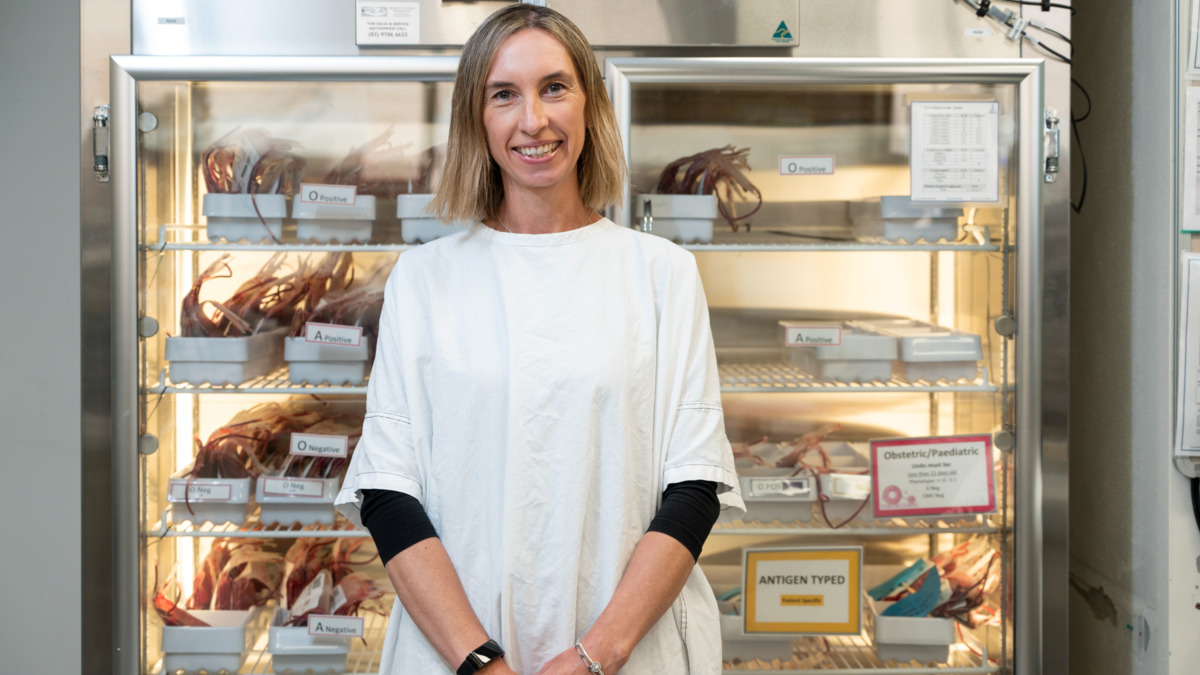
Blood bank scientist, Kelly Sliwinski, is working to reduce O Negative blood usage, and the results are paying off.
19 April 2022
Only 9% of Australians have ‘O Negative’ blood type. If you’re one of those, you’re a universal blood donor. This means that almost anyone can receive the red blood cells from your donations. Cool, huh?
As a blood bank scientist, Kelly Sliwinski, analyses blood samples to work out a patient’s blood group and whether they have any red cell antibodies that could be harmful during a blood transfusion or in pregnancy.
‘I then use this information to make sure we give compatible blood and blood products to patients who are bleeding, undergoing treatments or who have diseases which prevents them from making their own blood cells,’ says Kelly.
‘Blood is not just an off the shelf product. There are a total of 41 different human blood group systems and patients can have harmful reactions with any of them. There’s a great myth that you can just “give O Negative blood in an emergency”, but this is not always the case.’
‘Unfortunately, there are times that we will have to say no to releasing emergency issue O Negative blood, but it’s not without reason. There are some circumstances where emergency issue O Negative blood can be harmful.’
In recent times, we’ve seen nation-wide critical shortages of O Negative blood. This has been made worse in recent years with an increase in demand and usage of O Negative blood and decreases in donations due to flu and COVID-19.
To make sure this precious resource is available for those patients who genuinely need it, ACT Pathology, in collaboration with our Trauma and Anaesthetics teams and the Australian Red Cross Lifeblood, has worked hard to reduce the usage of O Negative blood products issued across Canberra Health Services.
As the Senior Transfusion Scientist at Canberra Health Services, Kelly says it’s been a big effort by everyone to reduce O Negative blood usage, and the results are paying off.
‘In 2020, O Negative blood use at Canberra Hospital averaged around 17%, but we’ve put in place a number of strategies and have reduce this to an average of 14% in 2021. This means almost 120 blood units were saved from being used – it’s a great result.’
‘We’ve promoted the use of red cell blood salvage, where the patient’s own blood is collected, washed and returned back to them. Moving patients receiving O Negative emergency issue blood to their own blood group or O Positive blood, where possible, has really helped.’
‘We’ve also reduced our blood wastage by using a new red esky to replace the old Lifeblood shippers which were large and not fit for purpose within the hospital environment. We also incorporated a real time remote temperature data logger, which provided our labs with critical temperature storage data while the esky is out of the lab.’
Another precious blood product that requires a management balancing act is platelets. Blood platelets last only seven days from the time of donation and if we hold too many at any one time, we risk not using them and they go to waste. But if we hold too little, we risk jeopardising patient care by not having them available when needed.
In 2021, we reduced our platelet discard rate from 11.8% to 6.7%, meaning almost 76 less units expired. This is well below the acceptable discard rate of 17%, set by the National Blood Authority.
Platelets are a precious resource that are always in high demand. It can take up to four donors to create a single unit of pooled platelets and they’re mainly used for patients who are undergoing cancer treatments, have blood cancers or are critically bleeding.
‘Canberra is unique in that we’re classified as a regional hospital, yet we’re a tertiary referral centre for the ACT and surrounding NSW region.’
‘As the major blood depository for our region, we need to be prepared for incoming traumas, major surgical and obstetric bleeds and to help support our regional NSW hospitals by providing blood stock in emergencies.’
While Canberra has an Australian Red Cross Lifeblood centre that keeps some stock on hand, we can’t rely on this stock alone. Blood is delivered from Sydney every day. Urgent deliveries to replace critical stock shortages can take up to six hours to arrive, with life threatening deliveries taking four hours.
‘The large tertiary and trauma hospitals located in the Sydney and Melbourne metro areas don’t need to do the same sort of fine balancing as we do here at CHS.’
‘Bushfires, flooding and COVID-19 have all also impacted on Lifeblood’s ability to deliver blood to regional areas like Canberra and they’ve done an amazing job to ensure that blood deliveries get to where they’re needed, when they’re needed.’
When asked what she’s most proud of about working in Haematology, Kelly says it’s being part of such an amazing team.
‘Everyone within Haematology is passionate and cares so much about the work we do, the patients and the service we provide to CHS and the community.’
‘Our doctors, scientists and technical officers all work together to provide the best outcomes we can for the patients, but we also look out for each other to make sure we’re all well supported.’
If you have a story you would like to share, get in touch.