
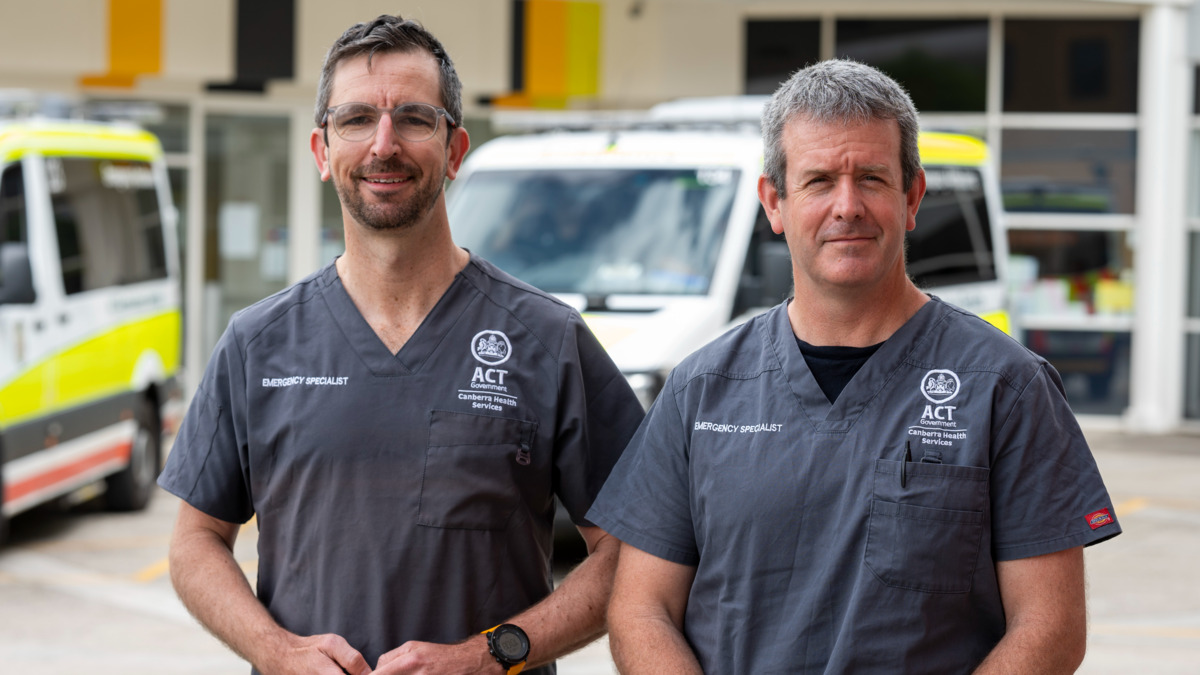
Dr Nicholas Taylor and Dr David Lamond have developed a simple new way to help save the lives of shark attack victims.
19 April 2022
The crucial minutes immediately after a shark attack can be the difference between life and death. No one understands this more than Canberra Hospital emergency doctors, Dr Nicholas Taylor and Dr David Lamond who have developed a simple new way to help save the lives of shark attack victims.
Keen surfer Dr Nicholas Taylor said he came up with the idea after a family holiday to Western Australia at a time when there had been a number of shark attacks.
‘After speaking to surf life savers and surfers, I found that most would react instinctively when bitten by placing direct pressure on the wound or by making a tourniquet from materials they had on hand. My emergency room training told me this would be a mistake. The better solution would be to cut the blood flow from the femoral artery, as we’re taught in medical school and regularly perform in emergency departments,’ says Dr Taylor.
The new technique relies on a second person making a fist and using a straight arm and their body weight to press it into a person’s groin at the central point between the hip bone and genitals, closing off the femoral artery to prevent someone from rapidly bleeding out.
To test the effectiveness of the technique, Dr Taylor helped organise a study of healthy volunteers that were given no prior training or instruction in how to apply the maneuver before attempting it, and the results were compared against the effects of using a makeshift tourniquet.
Dr Taylor’s new method of closing off the femoral artery stopped all of the blood flow in 75% of participants which makes it far faster and more effective than the commonly used first aid technique of using a surfboard leg rope as a makeshift tourniquet.
‘Now the goal is to see this incorporated into first aid training. To help, I’ve come up with a way of remembering the process: “push hard between the hip and the bits”,’ said Dr Taylor.
‘With more than eight people killed in Australia in 2020 from shark attacks alone, my hope is that this can now be used at beaches not only in Australia, but around the world to save the lives of surfers and swimmers following attacks.’
But before this can happen, the Australian Resuscitation Council will need to endorse the technique and incorporate it into their guidelines for managing bleeding wounds.
If you have a story you would like to share, get in touch.