
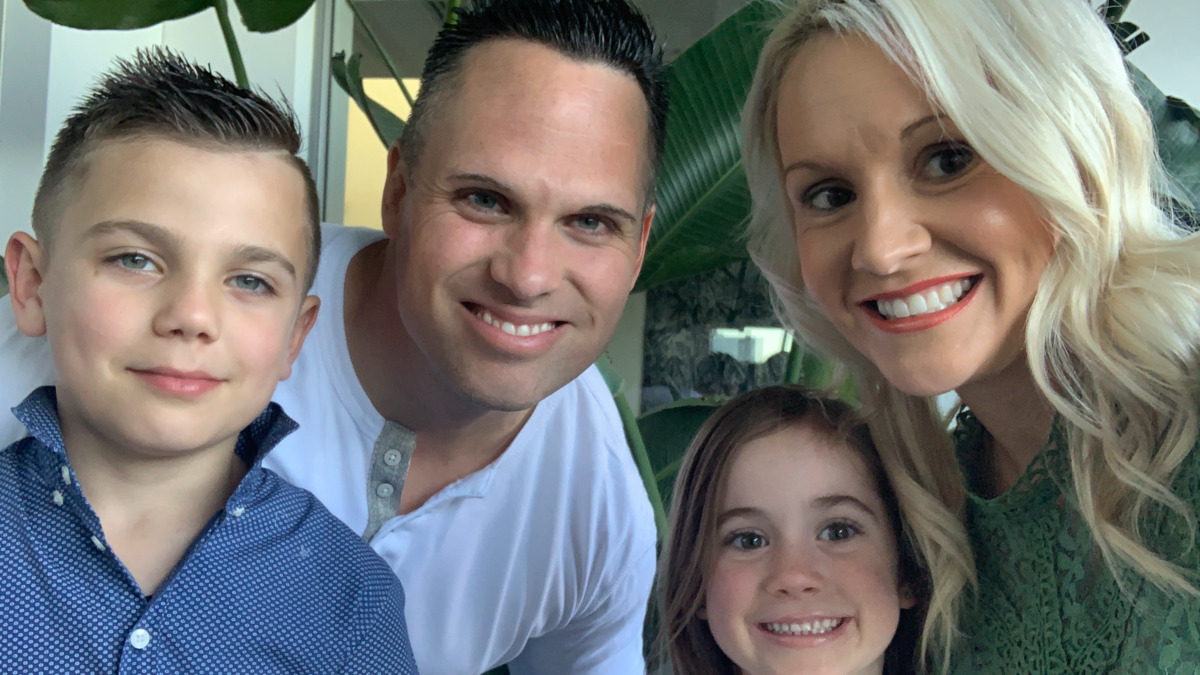
Sarah's husband, Josh, recognised signs of her stroke and called an ambulance.
14 August 2022
‘Late one Thursday evening, my husband arrived home from work and we were chatting about our day. As I was talking, I felt a really weird sensation in the left side of my mouth. I tried to tell my husband that something was wrong, however my speech was slurry. I went straight to a mirror to look at what was happening and could see that the left side of my face had dropped. My husband told me to sit down as he thought I was having a stroke. At this stage the left side of my arm lost feeling and my left leg/foot felt tingly.’
Sarah (pictured below with husband Josh and children Saxon and Charlee) had a stroke earlier this year. Luckily, her husband recognised the signs and acted quickly: ‘My husband immediately called an ambulance. He had a friend who had a stroke so immediately recognised the symptoms’.
Sarah was cared for by our Stroke Unit and has made a good recovery. ‘The nurses, doctors and specialists in the Stroke Unit provided me with the utmost care, with support from Neurologists, Speech Pathologists, Occupational Therapists and nurses. I got plenty of support to return home with and follow up phone calls to track my progress.’
A stroke occurs when blood cannot reach your brain because of a blocked or burst artery. It is one of Australia's biggest killers and a leading cause of disability.
‘Age is not always an indicator of stroke, if you recognise any symptoms don't ignore them, ensure you seek help.’
Shahla, Stroke Nurse Navigator at Canberra Health Services’ Stroke Unit, touched on the importance of seeking urgent medical treatment.
‘Unfortunately in Canberra, we have a population that sometimes presents to the hospital too late. Quite frequently patients will go to bed and try to stave-off their symptoms.’
If you think you or a loved one is having a stroke, you should call 000 immediately.
‘We are fortunate to have a dedicated four-bedded stroke unit and are one of the only Australian stroke centres to have dedicated 24/7 stroke nurses.’
Canberra Hospital is one of only 11 hospitals in Australia recognised as a Comprehensive Stroke Centre. In early 2021, the Centre began offering 24/7 endovascular clot retrieval (ECR).
ECR is an operation where a catheter is inserted into the femoral artery, via the groin, and fed all the way up to the part of the brain where a clot is causing the stroke.
Then a mini catheter is extended with a stent — described as a small flexible metal cage — which catches the clot and allows doctors to pull the blockage out again through the same blood vessel.
‘We are able to complete around 65 ECRs annually. Before the 24/7 service was offered in Canberra, patients used to have to travel to Sydney for the procedure.’
This time-critical treatment has had a really positive impact on stroke patients in the ACT and surrounding region.
There are actions you can take to minimise your risk of stroke.
‘80% of strokes are preventable through risk-factor modification, including ceasing smoking, consuming no more than ten standard drinks per week, maintaining a healthy diet, managing chronic conditions like high blood pressure and high cholesterol, and a really important one is regular exercise.’
In 2020, 27,428 Australians experienced a stroke for the first time. Globally, more than one in four people have a stroke in their lifetime. If you’re a smoker, you are two times more likely to have a stroke.
This National Stroke Week, Australians are being encouraged to learn the FAST (Face, Arms, Speech, Time) signs of stroke to ensure more people can receive the lifesaving treatment they need.
If you have a story you would like to share, get in touch.