
Tuckatalk: From Milk to More
Introducing foods to your baby
When to start solids
Your baby is ready to eat solids around 6 months of age. Around this time, start to give your baby different types of foods, starting with iron rich foods.
It is recommended NOT to begin solids before 4 months as:
- breast milk (chest milk) or infant formula provides all the nutrition your baby needs at this time
- your baby’s digestion, immune system, and kidneys are not fully developed yet so they are not ready for solid foods
- studies have found an increased risk of allergies when solids are introduced before 4 months
- Your baby’s chewing and swallowing is unlikely to be strong enough to manage solid food.
More information on allergies and introducing solids.
You can find more information at ASCIA: allergy.org.au and at ‘Nip Allergies in the Bub’: preventallergies.org.au
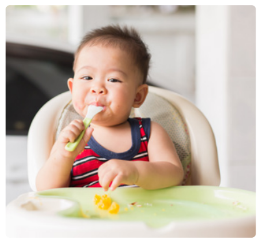
How do I know when my baby is ready to start solids?
Your baby may be ready to start solid food if they are around 6 months of age AND they can:
- hold their head up without support
- sit with support
- show interest when others are eating
- reach for food
- show awareness of their hands and fingers so they can join in feeding
- open their mouth when food approaches
- take most of the food into their mouth without their tongue pushing it out.
If your baby’s tongue pushes all the food out, they may not be ready. Try again in a week.
Giving your baby solids
At first, solid foods allow your baby to explore new flavours and textures. The amount of food your baby eats will change from day to day. Giving your baby lots of different foods is more important than the amount of food at this stage. Keep mealtimes relaxed and enjoyable. You may wish to feed your baby in a feeding chair, on your lap or seated on the floor next to you.
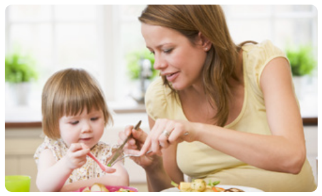
Supporting your baby in a feeding chair
Ensure your baby feels comfortable and stable in their feeding chair. Feeding chairs should have:
- a 5-point adjustable harness. To meet Australian Safety Standards the restraint harness should go over your baby’s shoulders, around their waist and between their legs
- a high back which supports your baby in an upright position
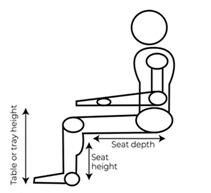
- an adjustable seat or tray height. Your baby should be able to rest their arms on the chair tray
- an adjustable footrest. Your baby’s feet should be able to touch and rest on a firm surface.
Position for eating
Your baby should be seated in their highchair, as shown in the diagram. Ensure your baby’s hips, knees and elbows are at 90 degrees with their feet resting on the footrest.
Your baby can be stabilised in their highchair by padding the back and sides of the chair with rolled up towels or cushions.
If you need extra guidance about your baby’s head and body control, talk to a paediatric physiotherapist or occupational therapist. Ask your GP, MACH nurse or dietitian about how to contact your local service.
Positive mealtimes
Promoting positive experiences at mealtimes will help your baby develop positive food habits and feel good about eating.
Division of Responsibility in Feeding
The Division of Responsibility in Feeding is a helpful guide to support pleasant mealtimes and helps your baby build a positive relationship with food.
As a parent or carer, your role is to decide:
- WHAT food is offered
- WHEN food is offered
- WHERE food is offered.
Your child decides:
- WHETHER to eat food that is offered
- HOW MUCH to eat.
For more information about encouraging a healthy relationship with food, visit the Ellyn Satter website:ellynsatterinstitute.org
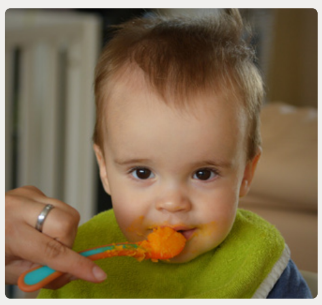
Responsive Feeding
The ‘Responsive Feeding’ approach helps create a positive eating environment, builds a trusting bond between you and your baby and supports your baby to develop a healthy relationship with food.
Responsive Feeding looks like:
- create a daily routine for mealtimes: start at a time of day when you and your baby are relaxed, such as after a breast feed or formula feed
- allow your baby to guide the feeds, let them decide when they have had enough to eat, this can look like:
- your baby turns their head away
- they push the spoon away
- they start crying
- sit down and eat with your baby, you are your baby’s best role model
- limit distractions during mealtimes, turn off screen activities such as TV, phones, and computers
- be patient with your baby, they are learning to eat, try not to pressure or force your baby to eat
- provide loving and positive words, for example “I love how you are trying new foods”, “I love seeing you enjoy your food”.
You can incorporate these feeding approaches into your daily routine in a way that best suits you and your family.
How to give your baby solids
Start by offering solid food after a breastfeed or formula feed or between feeds.
Choose a time of day when your baby is calm and not too tired.
- You may wish to have a support person with you.
- Put your baby in a safe sitting position. (e.g. in a feeding chair).
- Offer food once a day. Start with 1 teaspoon of pureed food and slowly increase according to your baby’s hunger levels.
- Use a small, soft, shallow spoon with smooth edges.
- You can start by offering one food at a time so that your baby can enjoy the flavour of each food.
- When your baby is managing around 2 to 4 tablespoons of food, you can offer solid food at a second mealtime and then at a third so your baby is eating 3 times a day.
- If your baby refuses a food (they may turn their head or spit out the food), continue to offer it without expectation or pressure. It may take up to 10 tastes (or more), at different meals, before a baby will learn to like some foods.
- Do not add solids to a bottle.
- Offer many different kinds of foods and keep offering them regularly.
- Throw out any uneaten food left on your baby’s plate. Do not store or reheat the food.
Remember the ‘Division of Responsibility’–let your baby decide how much food to eat.
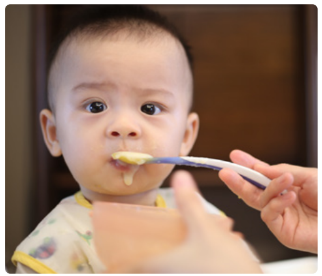
Food play
Allow your baby to see and reach for the food you are offering them. Let your baby hold a spoon or pick up food with their hands and feed themselves. This lets them learn about food, its texture and temperature. Try not to worry if it gets messy. Messy play is important for your baby to learn about new foods and to practice their eating skills.
Around 6 months of age:
What foods to offer?
- You can introduce foods in any order.
- Start with iron rich foods (such as well-cooked, pureed meat, pureed lentils, cooked and pureed tofu).
- Offer common allergy causing foods before 12 months of age to reduce the risk of developing an allergy.See ’Food Allergies’ section for more detail.
- If you are worried about allergic reactions, consider introducing new foods earlier in the day so you can monitor your baby.
- Choose food familiar to you, your family and your culture.
- Consider introducing one new food each day or at a rate that suits your baby.
- Pureed or finely mashed cooked fruits and vegetables can be offered.
- If starting with smooth and pureed foods, aim to move foods to a ‘lumpier’ texture within a few weeks
- If using pre-packaged foods, pour the food into a bowl so that your baby can see what is being offered. This will allow your baby to explore and learn about new foods through their sense of smell and sight.
See the Australian Guide to Healthy Eating at eatforhealth.gov.au for more information on the five food groups.
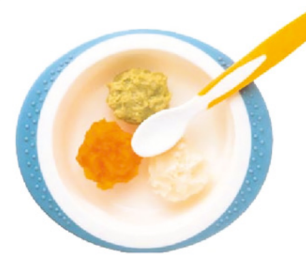
| Five food group ideas to offer when your baby is around 6 months of age | |
|---|---|
| Vegetables | Pureed cooked sweet potato, pureed cooked pumpkin, mashed avocado, mashed cooked broccoli, pureed spinach. |
| Fruit | Pureed papaya, mashed banana, pureed cooked apple, mashed mango, stewed fruit e.g. apple, pear. |
| Breads/cereals | Iron enriched infant cereal, porridge, semolina, pureed quinoa, polenta, toast fingers, WeetbixTM. |
| Meat and alternatives | Pureed lamb, pureed chicken, mashed lentils, cooked mashed eggs, pureed tofu, pureed kangaroo, nut butter. |
| Milk and dairy | Pureed paneer, full-cream plain yoghurt, cheese, calcium enriched soy drink, calcium enriched plant-based yoghurt, custard, milk on cereals, |
Preparing your baby’s first foods
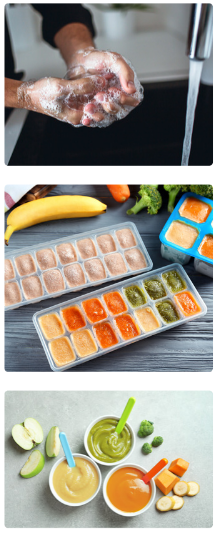
- Always wash your hands before preparing or touching food.
- Wash eating utensils in hot soapy water and rinse well. You do not have to sterilise them.
- Puree or mash your cooked fruit and vegetables with a sieve, fork or blender.
- Prepare small amounts of food, refrigerate and use within 2 days
- You can prepare larger amounts of food and freeze in ice cube trays:
- Once frozen, remove the frozen food cubes from the ice tray and store covered in the freezer for up to 1 month.
- Defrost individual cubes as needed.
- Defrost or heat cubes in a microwave oven or in a saucepan on the stove.
- Mix iron enriched infant cereal with breast milk, formula, cow milk or calcium enriched dairy alternative or cooled boiled water to a smooth consistency.
- Avoid adding salt, sugar or honey to your baby’s food.
Always stir food well and then check the temperature of the food (by tasting with a separate spoon) before giving it to your baby.
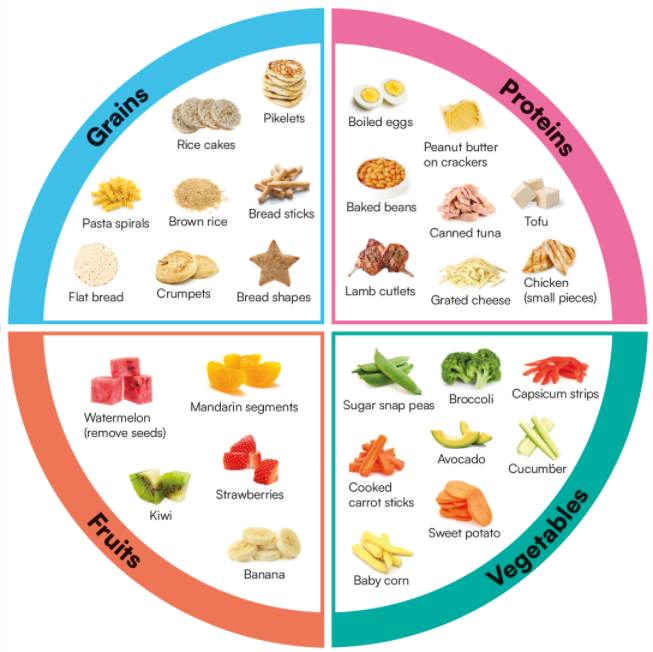
Finger Food
You can offer your baby finger foods from 6 months of age. This can be helpful if your baby is less interested in feeding from a spoon.
- Choose softer foods to start with and move onto harder textures as your baby grows.
- Choose a variety of foods of different colours from each food group.
- Always supervise your child while they eat.
- Avoid small, hard foods that can be a choking risk (nuts, chopped raw apple, raw carrots). Steam harder vegetables and fruits until they are soft.
- Cut meat and chicken into small pieces.
- Small, hard pieces of food can cause choking. Lightly steam vegetables and hard fruits so they are soft.
Alternative Methods of Introducing Solids: Baby Led Feeding
Baby led feeding is a popular way of introducing food to babies by letting them feed themselves from 6 months of age.
- Finger foods that are safe to chew and easy to hold are offered first.
- Purees and spoon feeding are not offered
- Baby led feeding is not recommended before 6 months of age.
- Baby led feeding is not recommended for premature infants or infants with developmental delay.
Canberra Health Services does NOT currently recommend baby led feeding as the standard approach for introducing solids to babies. There is currently not enough evidence on its safety and more research is needed on its effect on baby’s iron status, growth, and the risk of choking.
If you would like more information, please contact your Maternal and Child Health (MACH) nurse, dietitian, or speech pathologist.

Food Safety
Lower the risk of choking:
Young children under 3 years of age are at risk of choking because their back teeth, which are used to chew and grind foods into smaller pieces, have not completely developed. The food they swallow is therefore in larger pieces. If it ‘goes down the wrong way’ it’s more likely to block their airways causing them to choke. If your child is choking or having trouble breathing, call an ambulance/dial 000 immediately.
To reduce the risk of food borne illness:
- always wash your hands before preparing or touching food
- avoid raw or runny and under cooked egg due to salmonella poisoning risk
- cook all chicken, fish and meat well
- avoid giving your child honey until they are 12 months of age to reduce the risk of botulism
- discard uneaten food at the end of the meal.
For more information for dietary guidelines visit:
For children less than 3 years of age:
- make sure your baby is developmentally ready to eat before offering solids.
- avoid foods that can break off into hard pieces
- avoid popcorn, nuts (whole or crushed), hard lollies, corn chips and other small, hard foods
- avoid raw carrot, celery sticks and apple pieces: these foods should be grated, cooked or mashed
- remove tough skins from fruit (e.g. grapes and cherry tomatoes) and chop into quarters or halves
- cut meat, chicken, sausages and frankfurts lengthwise into smaller pieces; tough skins on frankfurts and other sausages should be removed
- check fish carefully for bones and remove if present
- always stay with your child and supervise them while they eat
- always sit children down to eat
- encourage children to eat slowly and chew well
- encourage children to feed themselves
- try not to rush your child and never force a child to eat
- avoid using pressure or bribery to encourage your child to eat
- only feed children when they are awake and alert.
7–9 months: progressing to thicker, lumpier textures
Increase the types and texture of food that you offer to your baby. Most babies can do chewing actions, even though some may not have teeth.
By 7-9 months most babies can hold a spoon and may enjoy learning how to feed themselves. Many babies also enjoy picking up food in their hands and self-feeding this way. Even though it may be messy, it is very important that you allow your baby to practise these skills.
Gagging
When introducing lumpier textures, your baby may spit the food out or gag the first few times. Gagging is a normal part of learning to eat and usually frightens parents more than the baby. Try not to react too much. Be reassuring.
Give your baby time to recover and offer more food when they are ready. If they do not want to eat any more at that meal stop feeding and try at another time.
Note: gagging is different to choking. Gagging is a natural safety reflex that helps prevent choking. Your baby will make retching noises if they are gagging. Refer to page 11 for more information on ways to help prevent choking.
Please note: delaying the introduction of lumpy, textured foods that require chewing may lead to feeding and speech problems when your baby is older.
Be sure to provide a variety of textures and include vegetables, fruits, dairy, cereals/grains and meats in your baby’s diet.
By 7-9 months, your baby will be enjoying a range of foods and having a few meals each day. Their daily routine may look something like this:
| Suggested ‘routine’ 7 – 9 months: | |
|---|---|
| Early morning | Breastmilk or formula feed. |
| Breakfast | Infant rice cereal (iron enriched) with mashed mango. Water in a cup. |
| Mid-morning | Breastmilk or formula feed. |
| Lunch | Minced lamb with mashed carrot and potato. Water in a cup. |
| Mid-afternoon | Breast milk or formula feed |
| Dinner | Family meal–stir fry, curry, or pasta, cooked soft and chopped into small pieces. Water in a cup. |
| Evening | Breast milk or formula feed. |
Note: Some babies may be having more than four breast or formula feeds at this stage
The ‘travelling through tastes and textures train’ can help you support your baby’s progression to family foods. It is intended as a guide only—every infant will progress through textures differently.
- Start when your baby is ready
- Eat with your child
Around 6 months Pureed foods - Let baby decide how much to eat
7 – 8 Months: Lumpy mashed and soft finger foods - Offer a variety of foods and textures
9 – 12 Months: Soft diced foods and finger foods
10–12 months: moving towards family foods
From 10 months of age, solid foods are becoming more important than breast milk or formula in your baby’s diet. The number of milk feeds a baby has will vary at this age.
Move your baby towards eating family foods and eating a range of foods with a variety of textures and flavour. Most babies will be eating three meals a day. The number of snacks eaten will depend on your baby’s sleep routine and appetite.
Your baby is becoming more independent and may want to be more involved in their feeding. Continue to encourage your baby to use their hands to feed themselves.
Helpful tip: offer food before breast milk or formula feeds from 10-12 months of age onwards or earlier if your baby shows little interest in solids as they transition towards family meals.
By 10 - 12 months, your baby’s daily routine may look like this:
| Suggested ‘routine’ from 10 months: | |
|---|---|
| Early morning | Breastmilk or formula feed. |
| Breakfast | wheat biscuit cereal mixed with cow's milk, toast spread with butter or margarine. Water in a cup |
| Mid-morning | soft diced fruit. Water in a cup |
| Lunch | soft chopped meat, chicken, fish or legumes with chopped soft vegetables or sandwich cut into pieces. Water in a cup |
| Mid-afternoon | chopped tomato, cucumber, cheese and crackers. Water in a cup |
| Dinner | family meal cut into small pieces. Fruit and yoghurt. Water in a cup |
| Evening | Breast milk or formula feed. |
Note: Some babies may be having more breast milk or formula feeds at this stage.
Spreads
Once your baby is eating bread, toast and crackers you may want to add a spread. Some spreads offer important nutrients while others offer very little. The following list will help you choose the most suitable spreads for your baby.
Recommended spreads:
- cream cheese, ricotta, cottage cheese–a source of protein
- hummus (chickpea spread)–a good source of protein and iron, use as a dip or spread
- smooth unsalted peanut butter (and other nut butters)–a good source of iron and protein
- tahini (sesame paste)–a source of calcium and healthy fats.
Spreads to use sparingly:
- yeast spread (Vegemite™)–a good source of B vitamins, high in salt, spread thinly
- margarine and butter–use sparingly unless otherwise advised
- chocolate spread (Nutella™)–high in sugar and fat, avoid or use sparingly
- jam–very high in sugar, can be offered sometimes.
Drinks
Breast milk or Infant formula
- Continue while introducing solids and until at least 12 months of age.
- The World Health Organisation recommends mothers continue breastfeeding children for up to two years of age or beyond.
Water
- Offer your baby boiled then cooled tap water from around 6 months of age. Offer this from a cup.
- After 12 months, you can offer your baby tap water without boiling it first.
- Tap water contains fluoride which helps reduce the risk of tooth decay. Discuss with your dentist if you are using or bottled water or rainwater.
Fruit juice
- Fruit juice is not recommended for babies under 12 months of age.
- After 12 months, small amounts of diluted pure fruit juice can be offered in a cup.
- Too much fruit juice can reduce your baby’s appetite for more nutritious foods and may cause diarrhoea and tooth decay.
Cow’s milk
- Cow’s milk should not be offered as a drink until 12 months of age but it can be used on cereal and in cooking before 12 months of age.
- From 12 months of age, milk should be offered in a cup.
- Excess cow’s milk (more than 500mls each day) can reduce your child’s appetite and lead to iron deficiency. After 12 months of age limit your child’s cow milk intake and encourage other dairy foods such as cheese and yoghurt instead to help meet daily calcium needs.
- Dairy foods such as yoghurt, custard and cheese may be offered from 6 months of age.
- Cow’s milk (or breastmilk or formula) may be cooked/mixed into foods.
- Unpasteurised or ‘raw’ milks may carry bacteria and should be avoided.
Soy milk
Calcium and vitamin B12 enriched soy drink is the best cow’s milk alternative, as it is high in protein, calcium and vitamin B12. Like cow’s milk, it is not suitable as the main milk drink until after 12 months of age.
Note: Reduced fat, low fat or ‘lite’ cow’s milk or soy milk is not recommended for children under 2 years of age. The fat in full cream milk is an important source of energy and fat-soluble vitamins. Milk offered to babies or toddlers should never be diluted.
Other ‘milks’
Calcium enriched nut, rice, oat and coconut drinks can be used after 1 year of age under the supervision of your dietitian or doctor. Choose full fat (not ‘lite’) varieties and include other sources of protein and vitamin B12 in your baby’s diet (e.g. meat, chicken, eggs).
Helpful tip: If your child has allergies to dairy and soy, speak with a dietitian to ensure your baby’s nutritional needs are being met. More information can be found on page 16 and on the Sydney Children’s Hospital Network: Milk allergy information sheet at: schn.health.nsw.gov.au/cows-milk-dairy-allergy-factsheet
Toddler milks/formula
Toddler milks/formula for over 12 months of age are generally not needed if your child is growing and eating well, unless your dietitian or doctor advises otherwise.
Unsuitable drinks for children under 12 months include:
- tea and coffee
- herbal teas
- soft drink
- fruit juices
- cordial
- flavoured milk
- cow milk or plant-based drinks
- anything that isn’t breastmilk, formula or cooled boiled water.
From breast/bottle to cups
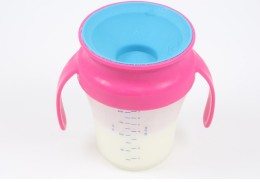
Babies can learn to drink from a cup, with help, from around 6 months of age. Start by introducing an open cup. To start you could use a plastic ‘sippy’ cup with the lid removed, preferably one with handles.
By 10-12 months of age, many babies may be able to manage an open cup. Allowing your baby to practice drinking from a cup will help increase their skills. A ‘sippy’ cup or straw cup can be useful when travelling, or when you are out but an open cup is recommended so your baby can develop their oral motor skills.
Food allergies
Continue to offer your baby the common allergy-causing foods to reduce the risk of developing an allergy, unless a reaction has been observed.
There is no proven way to prevent food allergies, but you may be able to reduce the risk. It is recommended that you DO NOT delay the introduction of commonly allergenic foods.
The foods most associated with food allergy are:
- cow’s milk (and dairy products e.g. yoghurt, custard, cheese)
- egg
- peanuts
- tree nuts
- fish
- soy
- wheat.
Introduce these from around 6 months of age and before 12 months of age while continuing to offer breast milk or formula.
Offer your baby common allergy causing foods including smooth peanut butter, tree nuts ground up or in a paste, cooked egg, cooked fish, pureed cooked tofu, dairy and wheat products in their first year. This includes babies at high risk of allergy. If you are worried about allergic reactions, consider introducing new foods earlier in the day, so you can monitor your baby.
You may like to introduce one new food each day during the daytime or at a rate that suits your baby. This will help you to identify a problem food if an allergic reaction occurs. Once you have introduced a common allergy food and no allergy symptoms occur, continue to include these foods in your baby’s diet at least twice per week.
For current information and guidelines on food allergies, see the ‘Allergy prevention’ fact sheets produced by Australasian Society of Clinical Immunology and Allergy (ASCIA) at allergy.org.au/patients/information.
What if my baby reacts to a food?
Some babies will develop food allergies. Most allergic reactions are mild to moderate and do not cause major problems. Symptoms from these may include:
- a skin reaction like a rash or welts
- vomiting
- diarrhoea
- an upset stomach
- runny nose/eyes or
- mild itch in throat.
If your baby has an allergic reaction to any food, that food should be stopped. You should seek advice from your GP who could refer you to a doctor with experience in food allergy (an Immunologist).
Some children may experience a severe allergic reaction called anaphylaxis which requires immediate lifesaving medication. This may present as:
- your baby having trouble breathing
- your baby’s mouth/tongue swelling.
If you are concerned, immediately go to the Emergency Department of your nearest hospital. You can then seek advice from your doctor for a referral to an Immunologist for further support.
For more information on allergic reactions, see the ‘Identifying Allergic Reactions’ section of the Nip Allergies in the Bub website at preventallergies.org.au/identifying-allergic-reactions
Fussy or picky eating
It is very common for young children to refuse foods at times as eating is a learned skill. Learning to eat takes time and practice. Support your baby to explore new foods as part of their playtime, to help them learn to accept and eat new foods.
You may wish to see a dietitian if you are concerned that your child is developing ‘picky’ or ‘fussy’ eating habits. Some clues to look out for are:
- Your baby consistently refuses new foods, or they are ‘picky’ most of the time only eating preferred familiar foods.
- Your baby finds new textures difficult, or they are slow to accept lumpier foods.
- Your baby has had consistently poor weight gain or dropped percentiles on their growth chart. You can find their growth chart in their ‘Blue Book’ and through their Digital Health Record (DHR).
- Your child still refuses or spits out mashed/lumpy or cut up foods at around 10-12 months of age.
- Your child has difficulty drinking from a cup at 16 months of age.
WYC Nutrition have available free online learning modules ‘Fussy Eating in Young Children’ on their webpage that parents can access anytime: canberrahealthservices.act.gov.au/services-and-clinics/services/women-youth-and-children-nutrition
What can I do to support my child to eat well?
- Eat together as a family to help your child learn about new foods.
- Consider playtime with food outside of mealtimes.
- Encourage your child to feed themselves and allow messy play.
- Have a consistent meal and snack routine to help your child learn about their appetite.
- Offer new foods many times even if they are rejected. Repeated exposure helps children learn about new food. It can take 10-15 exposures or more, before a baby may learn to like some foods.
- Avoid making a substitute meal or snack choice if offered food is rejected but always ensure you offer a food your child can eat.
- Offer new or less preferred foods along with a preferred food to help your child accept change.
- Offer buffet style meals so that your child can choose what they put on their plate.
- Never force your child to eat.
- Keep mealtimes pleasant.
When should I see a dietitian
If you have any concerns about feeding your baby speak with your MACH nurse, GP or dietitian.
To make this appointment with a dietitian in Canberra Health Services, phone Community Health Intake on 02 5124 9977.
You do not need a referral for this service, and it is free for Medicare and ACT Services Access Cardholders. In other states and territories phone your local Department of Health.
For further information visit:
- Ellyn Satter’s Division of Responsibility
- Raising Children network
- Supported by the Australian Government with information on a range of parenting topics including nutrition.
- ACT Government website with information on many aspects of parenting.
- Canberra Health Services website with information on community-based health services.
- Australian Government website with information on the amount and kinds of foods to eat for health and wellbeing.
- Aboriginal and Torres Strait Islander Guide to Healthy Eating.
- Official website of the Australian Breastfeeding Association.
- Food Safety Information Council of Australia website with downloadable fact sheets such as “Protecting tiny tummies – Preparing food for an infant or young child”.
- The Australasian Society of Clinical Immunology and allergy (ASCIA) website for up-to-date information on food allergy.
- Fact sheet on highchair safety produced by Kidsafe NSW website of New South Wales. Government Health
- Australian Family Partnership Program
- Yerrabi: Child & Family Aboriginal Corporation:
Sources
This content is based on current best practice in this field. Information has been collected from a literature review on infant feeding and the experiences of health professionals.
- National Health and Medical Research Council (2012). Infant Feeding Guidelines, Canberra: NHMRC, Commonwealth of Australia. nhmrc.gov.au/health-advice/public-health/nutrition/infant-feeding-guidelines
- Rapley, G (2011). Baby-led weaning: transitioning to solid foods at the baby’s own pace. Community Practitioner, 2011; 84(6): 20-3.
- Cameron SL, Heath AL, Taylor RW (2012). How Feasible Is Baby-Led Weaning as an Approach to Infant Feeding? A Review of the Evidence. Nutrients 4: 1575-1609.
- Satter, E. (1987). How to Get your Kid to Eat...But Not Too Much. Palo Alto, CA: Bull Publishing.
- Women’s and Children’s Hospital (2011) Preventing choking on food; Children Under 4 Years of Age.
- Netting MJ, Campbell DE, Koplin JJ, et al (2017). An Australian Consensus on Infant Feeding. Guidelines to Prevent Food Allergy: Outcomes From the Australian Infant Feeding Summit: pubmed.ncbi.nlm.nih.gov/28499774/
- Australasian Society of Clinical Immunology and Allergy (ASCIA) (2020). Allergy Prevention. ASCIA_HP_Clinical_Update_Infant_Feeding_and_Allergy_Prevention_2020.pdf
- ASCIA_PC_How_to_Introduce_Solid_Foods_FAQ_2024.pdf
- New South Wales Health. NSW Health [Internet]. NSW: Department of Health, [cited 2024 Mar 11]. Available from health.nsw.gov.au/Infectious/factsheets/Pages/botulism.aspx
- World Health Organization, WHO [Internet]. Geneva: WHO, [cited 2024 March 11]. who.int/health-topics/breastfeeding#tab=tab_1
- Rowell K, McGlothlin J. Helping your child with extreme picky eating : A step-by-step guide for overcoming selective eating, food aversion & feeding disorders. Oakland: New Harbinger Publication; 2015.