
Tuckatalk bottle or cup
Why Switch to a Cup?
An open cup is recommended for your baby.
Drinking from a cup will help your baby:
- Learn to sip rather than suck
- Develop the skills they need for eating, drinking and talking
- Depend less on a bottle
- Lower their risk of tooth decay.
When do I introduce a cup?
- Offer an open cup when your baby is around 6 months old. Give your baby a cup every time they have a meal or snack.
- Your baby can learn to drink from a cup while you continue to breast feed (chest feed) or bottle feed.
- Aim to switch from bottle to cup at around one year of age.
What cup to choose?
- Plastic or silicon cups are safe from breakage and easy to clean.
- Clear cups help you and your baby see how much fluid is in the cup
- Optional – two handles help your baby hold the cup when they are learning
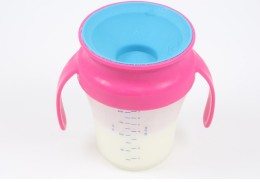
an example of a clear open cup
How to help your baby drink from a cup
- Make sure your baby is sitting upright, safely secured and comfortable ideally in a feeding chair.
- Your baby’s bottom needs to be well back in the chair with their knees bent and feet placed on the footrest. Rolled or folded towels may be placed behind, next to or under your baby to help keep them stable.
- When your baby is ready to try drinking from a cup offer them a small amount to drink.
Increase the amount offered as they get better at using a cup. - Help your baby hold the cup by placing it in both their hands.
- Encourage your baby to drink by saying their name and gently encourage with words such as "drink up" or "more drink". Let your baby decide when they have had enough to drink.
What drink do I put in my baby’s cup?
Before 12 months of age:
- boiled then cooled water
- expressed breast milk (also known as chest milk).
- a suitable infant formula.
After 12 months of age:
- tap water
- expressed breastmilk,
- a suitable formula,
- cows milk or
- calcium enriched plant milk.
What about sweet drinks?
Sweetened drinks such as fruit juice, fruit drink, cordial and soft drinks cause tooth decay so it is best not to offer these drinks to your baby.
What about sipper and straw cups?
Sipper and straw cups can be useful when travelling or when you are out. Otherwise always offer an open cup as this helps your baby practice skills needed for eating, drinking and talking.
What about spills?
Spills happen. Learning to drink from a cup takes time and practice. Ensure your baby always sits down to drink. You can put a plastic sheet under your baby’s feeding chair to make it easier to clean up spills. Have a cloth or towel handy in case you need to clean up spills.
What if my baby doesn’t want to use a cup?
Your baby can only learn to use a cup if they get the chance to practice.
- Make sure the cup is the right size for your baby’s age.
- A cup with handles may be easier for your baby to hold.
- Offer your baby a cup when they are alert and happy.
- Let your baby put the cup in their mouth and play with it when it is empty. This will help them get used to it.
- Be a role model. Sit with your baby and show them how to drink from a cup.
How can I help my baby to give up their bottle?
Replace bottles with a cup one feed at a time. A good place to start is with mealtime bottles. Offer expressed breast milk, formula or water in a cup instead. Keep the bottle out of sight. Settle or comfort your child by distracting them or giving them hugs to soothe them.
Where can I get more information?
Talk to your General Practitioner (GP).
Make an appointment with a Canberra Health Services (CHS) Community Dietitian by phoning (02) 5124 9977.
Or Scan this QR code:

- Visit the Australian Guide to Healthy Eating at https://www.eatforhealth.gov.au/guidelines/australian-guide-healthy-eating
- Visit the Aboriginal and Torres Strait Islander Guide to Healthy Eating at https://www.eatforhealth.gov.au/sites/default/files/2022-09/FINAL_ATSI_Guide_to_Healthy_Eating_A4_size_double_sided_POSTER_D15_1106141.PDF
For more support for Aboriginal and Torres Strait Islander mothers and children contact:
- Australian Family Partnership program: https://www.winnunga.org.au/afpp/
- Winnunga Nimmityjah Aboriginal Health and Community Services: https://winnunga.org.au/
- Yerrabi Yurwang – Child & Family Aboriginal Corporation: https://yerrabi.org.au/