
Health Information Sheet | Canberra Health Services
Stereotactic Radiosurgery for Brain Metastasis or Tumours
What is Stereotactic Radiosurgery?
Stereotactic Radiosurgery, also known as SRS:
- Is a way of delivering radiotherapy.
- Accurately and precisely focuses high dose radiotherapy on a small area of your brain.
- Can be delivered in a single session or over multiple sessions depending on the type, number, shape, size and location of your tumour(s).
- Does not involve surgery.
Why is SRS used?
SRS is used to:
- control the tumour in the location where SRS is given
- give relief from your symptoms
- avoid or delay the need for radiotherapy to your whole brain (if indicated) that may cause more side effects.
Precautions
- Before you consent to this treatment, please tell your Radiation Oncologist about
- any medicine(s) or treatment(s) you may be on.
- any changes in your medicine(s) or treatment(s) since your last appointment.
Planning and treatment processes
Planning steps
- Our team will organise an appointment for a magnetic resonance imaging (MRI) scan of your brain at the Canberra Hospital Medical Imaging Department. The MRI scan will take around 30 minutes. At the MRI appointment we will give you an injection of a contrast agent (called gadolinium) to help us see your tumor. We need you to have the MRI to:
- check that SRS is the right treatment for you
- accurately identify the area for treatment.
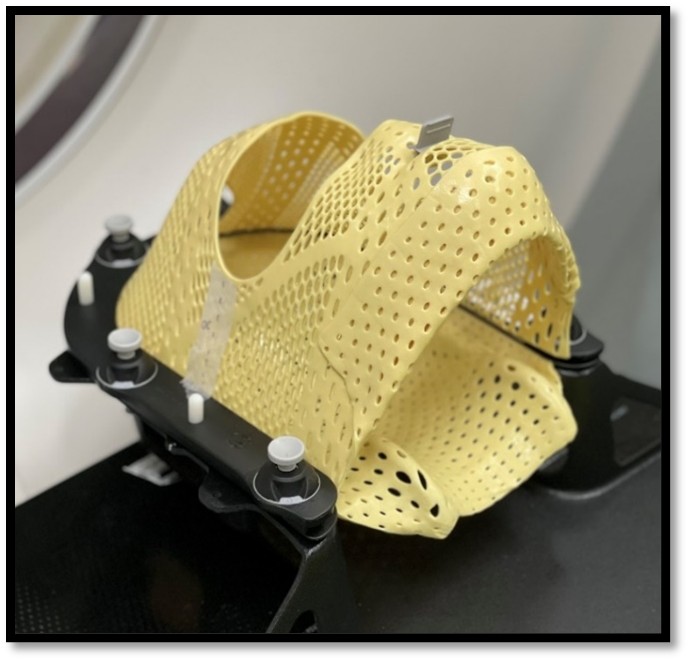
- A head mask is made for you in the Radiation Oncology Department. This is usually on the same day as your MRI appointment:
- The head mask helps you to keep very still to make sure we can give you your treatment in the most precise way.
- It will take around 40 minutes to make your head mask.
- If you are claustrophobic you can talk to your Radiation Oncologist about having anti-anxiety medication before mask-masking and before treatments and before we make your mask.
- A computed tomography (CT) scan of your brain is taken in the Radiation Oncology Department straight after your head mask has been made. The CT scan will take around 5 minutes.
- You need to have a CT scan so we can calculate the doses for your treatment.
- You will wear your head mask during this scan.
- We then develop your radiotherapy plan:
- Your MRI and CT images are overlaid to give us a combined picture.
- Your radiation oncologist, together with radiation therapists and medical physicists, will carefully develop a tailor-made treatment plan for you.
Treatment Steps
- Positioning your head for SRS delivery once you arrive for your treatment:
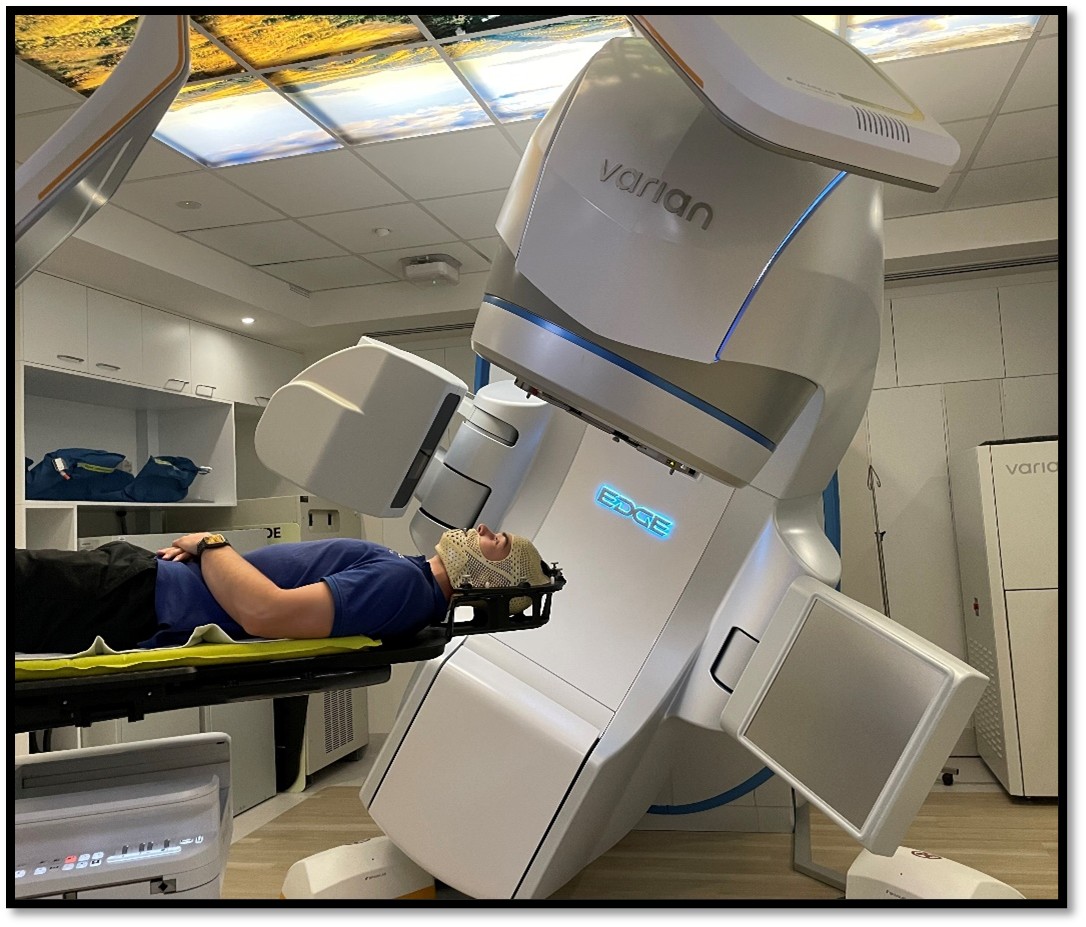
- You will lie down on the treatment bed and your mask will be worn to keep your head still.
- We will check your position by taking x-rays and making small adjustments to your position by moving the treatment bed.
- Radiation treatment delivery:
- Once you are in the correct position, we will start your treatment.
- Your treatment may be given from several different angles.
- The treatment time can vary from around 15 minutes to 40 minutes. Most of this time is used to get you into the correct position for accurate treatment delivery. The radiation is only switched on for a small part of this time.
- You will not feel or see the radiation and it will not cause you any pain.
Your medicine before your treatment
Before giving you this treatment, your Radiation Oncologist may give you these medicines if you need them:
- Dexamethasone (steroid)
- This can help prevent or reduce brain swelling after your treatment:
- If you are not already taking this medicine, we will give you a single dose before each of your treatment sessions.
- If you are already taking this medicine, we will tell you what dose you should take before your treatment and what dose you should continue to take after your treatment.
- This can help prevent or reduce brain swelling after your treatment:
- Anti-anxiety medicine
- We may give you a medicine to help you feel relaxed if you feel anxious wearing the comfortably fitted mask.
What are the side effects of treatment?
Side effects of this treatment are divided into two categories – early and late.
Early side effects
- may develop during and/or within a few weeks after radiotherapy
- generally resolves a few weeks after they start.
- Relatively common:
- Mild tiredness
- Mild patchy reaction to the skin over the scalp like sunburn
- Patchy hair loss on your scalp (this can be temporary or permanent)
- Uncommon:
- Headache, nausea, vomiting and worsening of pre-existing neurological symptoms (your risk is reduced by taking dexamethasone tablets at the time of your treatment)
- Rare:
- Seizures
- Stroke
Late side effects
- may develop months to years after radiotherapy
- may be permanent
- are rare but can be potentially serious.
- Rare:
- Temporary drowsiness (somnolence syndrome)
- Decline in memory and concentration (neurocognitive impairment) depending on where in the brain the treatment happened.
- Damage to the treated brain tissue (radiation necrosis) causing brain swelling.
- Very rare:
- Cataract development
- Nerve damage resulting in muscle weakness, numbness, pain, pins and needle sensation, hearing or visual loss
- Pituitary dysfunction which can lead to changes of vital hormones in the body (depending on where in the brain the treatment happened)
- Seizures
- Stroke
- Radiation- induced second cancer
After your treatment
It is important to follow the instructions below.
- If you have headaches, nausea or vomiting after receiving your treatment:
- please contact your radiation oncologist/radiation oncology registrar on (02) 5124 8444 from 8am to 5pm, or,
- the on-call radiation oncologist/radiation oncology registrar via the hospital switchboard at (02) 5124 0000 after hours.
- If you have any of the symptoms listed above and they are very severe or develop any other new neurological symptoms (for example: weakness, numbness, seizure), go immediately to your nearest hospital Emergency Department or call 000.
Follow up appointment
When you have completed your treatment, we will:
- tell you the date and time for your follow up appointment
- give you a referral for an MRI scan or make an appointment for an MRI scan. This helps us to monitor the response of your tumour(s).
- make sure that if you were taking dexamethasone before you received this treatment, the dose you keep taking is right for you.