
Preventive dental treatments for children
Preventive dental treatments are services designed to help maintain oral health and prevent future dental problems. Preventive dental treatments include fluoride varnish, scale and clean, and fissure sealants. Depending on your individual need, your dental professional may recommend one, or several, preventive dental treatment option/s.
Fluoride varnish
What is fluoride varnish?
How is fluoride varnish applied?
First, the teeth are dried with air or cotton rolls. Then a small amount of fluoride varnish is applied to the teeth with a small brush or applicator. Once applied, the fluoride varnish is sticky but hardens on contact with saliva within a few minutes. The varnish will wear off on its own. For best results, we recommend you don’t eat or drink for 30 minutes, and no brushing for 4-6 hours after the fluoride varnish has been applied.
What are the risks of fluoride varnish?
Allergic reactions to fluoride varnish are rare but possible. In extreme cases, you may have trouble breathing. If you experience difficulty breathing, please call 000. If you have a mild reaction, such as inflammation of the gum, you can brush the teeth and rinse the mouth to remove the fluoride varnish.
Let your dental professional know if your child has:
- hypersensitivity or allergy to colophony (natural resin) or milk protein so they can use a different type of fluoride varnish,
- asthma, or
- mouth ulcers or sores in the mouth (we may need to delay fluoride varnish application).
Fissure sealants
What are fissure sealants?
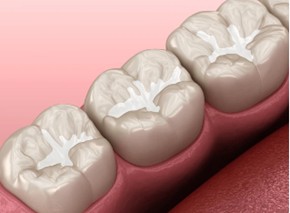
A fissure is a natural groove on the biting/chewing surface of a back tooth. These fissures can be deep and narrow. This makes it hard for toothbrush bristles to get in and clean it. The tooth may also be hard to reach and clean. Because of this, tooth decay can start in these fissures.
How are fissure sealants applied?
Fissure sealants are simple to apply. No drilling is needed. We may take an x-ray to make sure the teeth don’t have any decay. It usually takes about 5 minutes per tooth and is painless.
- The tooth is cleaned with a brush.
- A cleaning solution is put on the tooth and then washed off.
- The tooth will be kept dry so the sealant can stick to the tooth properly.
- The liquid sealant is applied to the tooth with a small brush or applicator. The liquid sealant flows into the fissures of the tooth and may be set hard with a special light. This leaves a thin layer of white material in the fissure.
- Your dental professional will check the sealant does not interfere with the way your teeth bite together. The sealant may feel unfamiliar at first, even when it is checked.
What are the risks of fissure sealants?
Teeth cleaning (prophylaxis and dental scaling)
What is teeth cleaning (prophylaxis and dental scaling)?
Sometimes plaque, calculus (hardened plaque) or stains can build up on your teeth and can’t be removed by toothbrushing at home. We may use a professional electric toothbrush and cleaning paste to clean away any plaque and stains from the surface of your tooth. This is called dental prophylaxis. Dental scaling is when we use a small instrument to gently lift away any calculus (hardened plaque) that may have collected on the surface of your teeth.
What are the risks of teeth cleaning?
Risks with teeth cleaning are minimal. As plaque and calculus can irritate your gums, you may have sensitive teeth or bleeding gums following a dental clean. Bleeding often settles quickly and sensitivity generally goes away within two days. Let us know if your doctor has told you that your child needs antibiotics before dental treatment, we may need to delay the clean.