
Perineal Massage
What is the perineum?
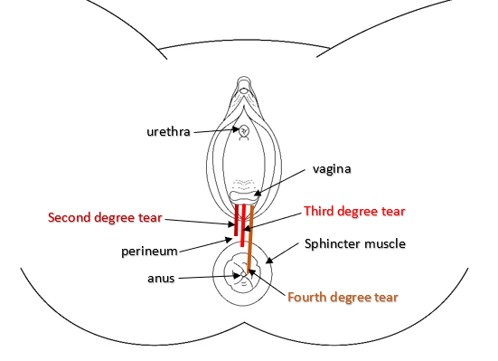
The perineum is the area of skin and muscle between the opening of the vagina and anus. During childbirth the perineum will stretch and may tear.
What is a perineal tear?
Tearing is a common part of vaginal birth, and our bodies can recover from a perineal tear very well in most cases.
Most tears include the skin and/or muscles of the perineum. These are called first or second degree tears and may require stitches to assist healing.
Tears that extend further than first and second degree tears can affect the muscles and lining of your anus. These are less common and need extra medical care as they require a more complicated repair and recovery. These are called third or fourth degree tears, or anal sphincter tears. The anal sphincter is the circular muscle surrounding and controlling your anus (back passage).
You may be more at risk of perineal tears if you are having your first baby, during a quick pushing stage, during a long pushing stage, your baby is larger or if you have an assisted vaginal birth with forceps or vacuum
What can I do to protect my perineum during childbirth?
Pelvic floor exercises are an excellent way to prepare your perineum for birth. This should include both strength training and relaxation. Having an awareness of your pelvic floor can improve your ability to relax the pelvic floor on demand, which is important to reduce your risk of tearing during birth.
Perineal massage is also something you can do before birth to reduce your risk of tearing.
What is perineal massage?
Perineal massage is a stretch of the tissue at the opening of your vagina. This helps your perineum get used to the stretching that will happen when you have your baby. You or your partner can do this massage.
The benefits of doing perineal massage before birth may:
- Reduce the need for an episiotomy. An episiotomy is a cut of the perineum performed by the midwife or doctor to help increase the vaginal opening to birth the baby.
- Shorten the pushing stage and reduce perineal pain after birth
- Lower the risk of a third or fourth degree tear
- Lower the risk of bowel incontinence
Perineal massage also helps you to practice breathing and relaxation, so that when your baby comes, you are ready for the stretching sensation and can breathe through it more easily.
When and how often should I do it?
Start perineal massage when you are 34 weeks pregnant. Keep doing it 1 or 2 times a week until you have your baby. Warm muscles stretch easier so having a warm shower or applying a warm face washer to the area for 5 to10 minutes prior to massage may help with the steps below.
How do I do it?
- Empty your bladder before you start.
- Make sure you and/or your partner’s hands are clean and nails short.
- Get comfortable. You can sit on the edge of a chair or the toilet. You may prefer to rest on your bed if your partner is going to help you.
- Use a mirror to help you. Avoid pushing on your urethra (urinary opening above the vagina). Staying away from this area will prevent injury or infection.
- Use your fingers to apply the lubricant to your perineum. This could be either a water-based lubricant or a natural edible oil (almond, olive or coconut). Don’t use anything containing mineral oils such as paraffin or petroleum jelly.
- If doing the perineal massage yourself, insert both thumbs inside the lower part of your vaginal opening (3 to4cm). If your partner is assisting, they may prefer to use their index fingers.
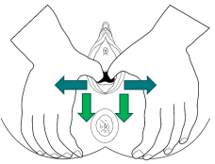
- Press gently but firmly down towards your anus and out to the side until you feel a stretching/stinging sensation. Keep this pressure while you gently, move your thumbs side to side in a ‘U’ shape.
- Continue for two minutes. Focus on controlling your breathing and trying to keep your muscles relaxed. Release the stretch, then repeat these steps for another two minutes.
- After holding the stretch, massage your perineum with slow strokes or circles between your thumb and index finger.
- While you or your partner are stretching the perineum, keep your tummy, bottom and pelvic floor relaxed. Breathe slowly and focus on something you find calming (e.g. your partner’s voice, music, a restful image or counting). This can also be helpful to do when in labour.
- If your partner is helping you, it is important to clearly tell them your level of discomfort.
What do midwives and doctors do to reduce my risk of tearing?
- With your consent, we will hold a warm pad to your perineum as your baby's head is crowning, to help warm the skin and muscles of the perineum.
- We will tell you when to stop pushing to birth your baby's head and shoulders slowly.
- We may offer you an episiotomy (a cut to your perineum) to avoid larger tears.
When should I avoid doing perineal massage?
- Don’t do perineal massage if you have an infection or an active condition like herpes.
- If your waters have broken check with your primary carer before doing perineal massage.
- If you are experiencing bleeding from the vagina.
How can I find more information?
Phone:
- The Canberra Hospital, Women’s Health Physiotherapy
Phone: 5124 5921 OR email: whphysio@act.gov.au (pregnancy care and 0-3 months postnatal) - North Canberra Hospital Women’s Health Physiotherapy
Phone: 5103 6190 (pregnancy care and 0-3 months postnatal)
Visit
Pregnancy Birth and Baby - 1800 882 436, www.pregnancybirthbaby.org.au