
How to care for your new gastrostomy tube
A gastrostomy tube goes through an opening in your abdomen into your stomach.
Gastrostomy tube insertion sites can be painful for up to 7 to 10 days. We suggest that you take regular pain relief as prescribed by your doctor.
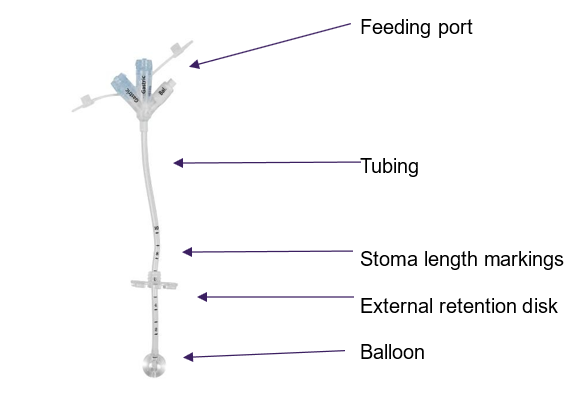
How long will the gastrostomy tube last?
The tube is designed to be used for several months. Some people may need these tubes permanently. Your doctor will recommend when your tube is removed and will discuss this with you.
Taking care of your tube
Do not use the tube for 24 hours after the insertion. After this you can flush the tube with tap water. Instructions on how to flush your tube are below under ‘Flushing your tube’. Your nurse or dietitian can show you how to do this.
- Wash your hands before touching the tube or insertion site
- Remove the dressing and shower 24 hours after tube placement. You can ask us for extra dressings to take home
- Some oozing (e.g. blood, clear fluid) around the insertion site is normal. It is important to keep your skin around the tube and silicone plate or flange clean and dry. If you need new dressings you can ask your community nurse or treatment team.
- check the skin around the tube for redness, tenderness, swelling, draining or gastric leakage and report any of these changes to your treating team or community nurse.
- Do not tuck your tube into your underwear or other clothing. If you have a long tube, secure it with paper tape or secure it underneath your clothing or with “stretch netting” we can give you this if you need it.
- Avoid lifting any heavy objects or strenuous activity that uses your abdominal muscles (like sit ups) for 2 weeks after your tube is inserted.
- Once the site is no longer painful, rotate the tube 360 degrees gently between your fingers once a day. Your community nurse or treating team (your speech pathologist, or Head and Neck Cancer Specialist Nurse) can show you how.
- There may be some small buttons or anchors (these hold the tube in place) next to the tube. These may come off or be taken off by your nurse 1-2 weeks after your tube is inserted. If they become painful, report this to your nurse or doctor.
Please seek medical advice if you are experiencing severe abdominal pain, bloating, diarrhoea, constipation, vomiting, high temperature, low urine output or bleeding. You can seek medical advice from the Cancer Rapid Assessment Unit phone (02) 5124 4401 or present at the Emergency Department, Canberra Hospital.
Flushing your tube
- Check your tube is in the correct position before flushing or feeding (the position will be confirmed with you before leaving hospital by the medical team).
- Flush your tube regularly with tap water to prevent blockages. Start flushing your tube with water 24 hours after insertion. It is recommended to flush with 60mL of tap water twice a day at a minimum (morning and night).
- Do not bend the tube when opening the caps on the tube as bending can cause splits in the tube over time. Hold your tube upright to stop stomach fluids from leaking out when you are opening the caps.
- Use a start/stop flush action to create a turbulent flow.
- Always flush your tube with 60mL water before and after a feed or medications.
To reduce the risk of reflux you need to stay semi- upright (minimum 30 degrees) during feeding and for 30 to 60 minutes after feeding.
Tube blockages
- Tubes should be easy to flush, so do not force water into the tube.
- Check that the feeding tube is not kinked.
- Gently massage the tube with your fingers if the blockage is visible.
- If this doesn’t remove the blockage, fill a 60mL syringe with warm water and gently try and flush your tube. Only use water to try and unblock your tube.
- If it is still blocked, try pulling back on the plunger of the syringe and hold for 10 seconds then gently push the plunger forward.
- If this is unsuccessful, contact the community nurse and/or your treating team at the hospital. You could also present to the nearest Walk in Centre or Emergency Department.
Please only put nutritional supplements through your tube, as advised by the dietitian.
Pureed foods and smoothies can harm the tube or cause a blockage.
What if my tube comes out?
- Don’t panic if your tube comes out. There are processes for managing this, and it is important that you act quickly as the stoma (where your gastrostomy tube is inserted) can begin to close.
- You can call the Cancer Rapid Assessment Unit phone (02) 5124 4401 for guidance or contact the Head and Neck Cancer Specialist Nurse whose phone number will be provided to you at your first consultation.
- If you are known to the community nursing team, call them for guidance. If it is after business hours you will have a mobile phone number to contact them.
- If you have a replacement tube at home insert the tube, to keep the stoma open. If the tube has a balloon do not inflate the balloon. Carefully secure the tube to the skin with tape. Get medical assistance as soon as possible. Do not use the new tube for water, feeds or medication until correct placement has been confirmed by a nurse or doctor.
- If you have no replacement tube you need to present to the nearest emergency department for replacement of the tube as soon as possible.
If you have any questions, you can contact us on: ___________________________________