
Caring for your haemodialysis central venous catheter
For all medical emergencies call “000”
What is a haemodialysis central venous catheter (CVC)?
A haemodialysis central venous catheter (CVC) is a soft plastic tube placed in a large vein—most often in your neck. It is held in place with stitches and a dressing. The CVC is used to move blood from your body into a dialysis machine that filters out waste products. This is known as haemodialysis. The filtered blood is then returned to your body through the CVC. Other names for CVC include Permacath, Hickman’s, Vascath, and tunnelled catheter.
Who can use my CVC?
Only a dialysis nurse can use your CVC to take blood or connect you to the dialysis machine.
Other nurses or doctors must not use it, except in an emergency.
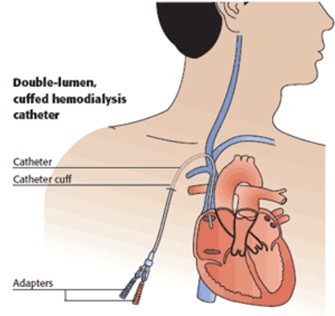
How do I take care of my haemodialysis CVC?
Check your CVC and dressing every day and make sure:
- The dressing is clean, dry, and firmly covering the CVC site.
- There is no redness, swelling, pain or discharge.
- Both clamps are closed.
- There are no cracks or holes in the catheter tube.
- Protect the CVC from being pulled, tugged, or kinked.
- Keep the area dry.
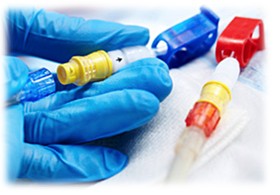
Your dialysis nurses will teach you how to care for your CVC and provide you with an emergency pack. Use this sheet to help you remember the key steps.
How do I take care of my haemodialysis CVC Dressing?
Do not shower for the first 3 days after your catheter is inserted.
After day 3:
- Use a hand‑held shower and keep the dressing dry
- Cover the catheter with a plastic bag and seal it with tape to keep water out.
- Do not use scissors to remove the plastic bag.
Video Information on CVC protection
Below is a short video on CVC care called Permacath protection. Source with permission from NSW Health Illawarra Shoalhaven Local Health District: https://www.youtube.com/watch?v=U4z6yPilbtI
If your dressing becomes loose or falls off
- Wash your hands.
- Secure the area with clean surgical tape or clean gauzefrom your emergency pack.
- Contact your dialysis unit for a dressing change as soon as possible.
If the haemodialysis unit is closed, go to your nearest Emergency Department.
Things to avoid
- Pulling, scratching, pinching, or twisting the catheter.
- Sharp objects near the catheter or dressing (including scissors and razors).
- Swimming or bathing (fully submerging in water).
- Perfume, powder or makeup near the catheter site.
- Pressure on the catheter (for example, a shoulder bag resting on it).
Risk of central vein stenosis
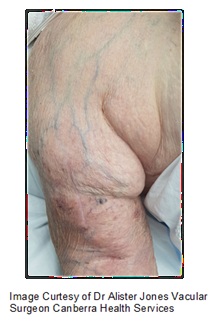
There is a risk of central vein stenosis (narrowing of the large veins in the neck or chest). This can cause arm, chest or neck swelling, pain, or discomfort. Damage to these veins may limit options for a permanent dialysis access (such as a fistula) in the future, especially on the affected side. Talk with your kidney doctor about your best option for long‑term access.
Risk of infection
Bacteria can get onto the CVC from the skin insertion site and into deeper tissues and the bloodstream. This is why we should only consider having a CVC as a temporary measure.
Signs of infection can be seen in the images below and must be reviewed by the dialysis access nurse for management. In most infection cases, this will involve removing the CVC.
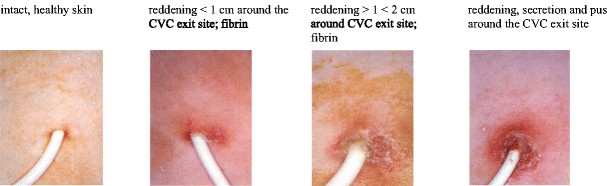
Contact your haemodialysis unit within business hours as soon as possible if you notice any signs of infection:
- Fever, chills, sweating or nausea.
- Pain or discomfort at the site.
- Redness, swelling or fluid leaking where the CVC comes out of your skin.
- The catheter has fallen out, or you can see more of it than usual.
If you develop fever or chills, go to your nearest Emergency Department immediately.
Emergencies
Your catheter breaks or is cut:
- Clamp the catheter, to stop air and blood flow.
- Use the catheter clamp provided.
- If no clamp is available, fold/kink the catheter.
- Lie down flat.
- Call 000 for an ambulance.
The cap comes off:
- Make sure both clamps are closed.
- Wrap the end with sterile gauze from your Emergency Pack and tape it securely.
- Call your Dialysis Unit or the Emergency Department—the cap needs to be replaced urgently.
Your catheter falls out:
- Do not push it back in.
- Press firmly on the site and lie flat.
- Keep pressing for at least 5 minutes until bleeding stops.
- Cover with a clean dressing.
- Seek medical help immediately.
Emergency CVC pack
Your dialysis nurses will provide emergency packs. You can have more than one- always keep one pack with you. Each pack contains:
- Gauze swabs
- Surgical tape
- Blue scissor clamps
- Antiseptic swabs
- Dialysis Alert Card
- End caps/bung
Contact
Business hours:
- Monday to Friday 8am to 4:30pm
- Canberra Hospital Dialysis Access Nurse
Ph: (02) 5124 4564
After hours:
If you have a fever and/or chills, or if your CVC insertion site is bleeding, go to your nearest hospital Emergency Department or health facility.