
Caring for your cannula
How to care for your cannula
What is a cannula?
A cannula is a short, small, flexible and hollow plastic tube. It is put into your vein through your skin using a needle. The needle is removed and the plastic tube remains.
A cannula is used to give medicines, fluids and blood products directly into your bloodstream. Your cannula may also be called an ‘IV’, ‘drip’, ‘needle’, ‘intravenous catheter’ or ‘intravenous cannula’.
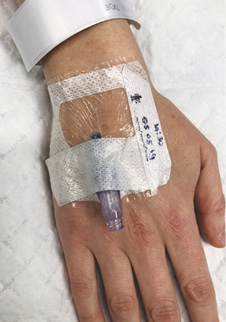
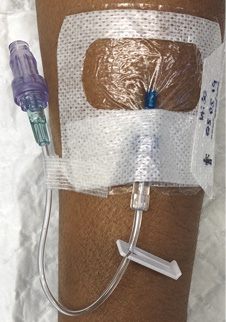
Your cannula will be secured with a see-through, waterproof dressing and dated. It will also have a ‘bung’ or an ‘extension set’ attached to the end as shown in the pictures below.
How long can a cannula stay in for?
Your cannula can stay in for up to 72 hours (3 days).
After this we will remove it. If you still need treatment, we will put in another cannula.
Your cannula will only stay in for longer than 72 hours in special cases and only if an expert nurse or doctor says that it can.
If your cannula was put in during an emergency or by the ambulance, we will remove it within 24 hours and may put in another cannula.
Please remind us if this has not happened.
What are the risks of having a cannula?
A cannula can become infected, inflamed, or blocked. It can also leak, bruise your skin or fall out.
Infection
There is a risk of infection any time your skin is broken. As a cannula is put into your vein through your skin, there is a risk you may develop an infection.
Fall out
Your cannula is held in place by a see-through dressing. If the dressing becomes loose, or the cannula is pulled, the cannula may fall out.
Bruising
If it is difficult to put your cannula in, you may have some bruising. Some medical conditions can also cause bruising.
Inflammation
Some medicines we give you in your cannula may cause inflammation where your cannula enters the skin. This may cause pain, swelling or redness. If this happens, we will remove your cannula and replace it.
Leaking
Sometimes a cannula will ‘tissue’ or leak. This is when the fluid or medicine leaks out of the vein and into the area around the vein. If this happens, we will remove your cannula and replace it.
Blocked
Cannulas can become blocked. If this happens, we will remove your cannula and replace it.
How will my nurse or doctor care for my cannula?
Nurses and doctors will:
- Clean their hands and wear gloves before and after touching your cannula and any connected lines. It’OK to remind them if they haven’t.
- Regularly check your cannula and its dressing for signs of infection, leakage, blockage or inflammation.
- Put a date on your cannula dressing after your cannula is put in and check the dressing to make sure it isn’t loose or lifting.
How can I help care for my cannula?
- Protect your cannula and any connected lines from being pulled or knocked. You can do this by being careful when getting dressed or moving around. Ask a nurse or doctor if you need some help.
- Try not to touch the cannula. Never disconnect any connected lines from the cannula yourself or ask for them to be disconnected. Disconnecting your cannula can increase your risk of infection.
- When showering, please try to keep your cannula dry by protecting it from water. After your shower, please pat the dressing dry and do not rub.
Let your nurse or doctor know if:
- you have any leaking, swelling, redness or pain around the area where the cannula has been put in
- your cannula, the dressing or bung on your cannula becomes loose
- your cannula falls out.
If you are bleeding from where the cannula has been put in, please apply pressure to the area to help stop the bleeding. Call your nurse or doctor for help.
Important information
Most people must have their cannula removed by a nurse or doctor before leaving the hospital.
Please remind us if this has not happened.
We will tell you if your cannula needs to stay in and organise its removal at a later date.
If you have any questions about your cannula or the information, please talk with your nurse or doctor.
References:
- Australian Capital Territory Health (2017) PICC. [Brochure]. Australian Capital Territory, Australia: Author
- Australian Capital Territory Health (Photographer) (2019). Intravenous cannula without extension. Australian Capital Territory, Australia: Author
- Australian Capital Territory Health (Photographer) (2019). Intravenous cannula with extension. Australian Capital Territory, Australia: Author
- Lakes District Health Board (2009). Your intravenous luer (cannula) [Brochure]. Rotorua, New Zealand: Author
- South Eastern Sydney Local Health District (2014). Caring for your cannula. [Brochure]. Sydney, Australia: Author
- National Health Service Western Isles (2017). Caring for your cannula. [Brochure]. Stornoway, Isle of Lewis: Author
- National Health Service Liverpool Community Health (n.d). Intravenous cannula. [Brochure]. Liverpool, United Kingdom: Author