
Antenatal Expressing
Antenatal hand expressing is the collection of colostrum from 36 weeks of pregnancy. Colostrum is the first milk produced by the breasts from around 16 weeks1. It is cream, yellow, or clear in colour and can be quite thick and sticky1
Colostrum is the ideal first food for your baby. Although only a small amount of colostrum is produced, it is very high in energy, fat and protein6. Colostrum contains antibodies which colonise your baby’s gut, protecting them against allergy and disease4. It can also stabilise a baby’s blood sugar level, it is easily digested (assisting with the early passing of meconium – baby’s first bowel movement) and it is the only nutrition and fluid a healthy baby needs 1,,3.
Why is antenatal expressing helpful?
Some babies may need more fluid or nutrition after birth than they can get directly from their mother1. In these situations, having expressed colostrum on hand can mean you may not need to use unplanned formula. Some women may not be able to collect any colostrum, this is very normal and is not a sign you will not have enough milk. The practice will still be very useful for when you have your baby.
Diabetes
If you have diabetes during pregnancy, your baby is at risk of having low blood sugar after birth1. Providing colostrum to your baby early can help stabilise the baby’s blood sugar1. Giving colostrum has been shown to improve exclusive breastfeeding for babies2, 3.
Caesarean Section
If you are having a planned caesarean, you may be encouraged to express colostrum if your baby cannot feed as soon as possible after birth7. Expressing will continue 8-10 times every 24 hours until your baby is feeding regularly7.
The potential benefits of expressing during pregnancy
All women who would like to express antenatally are encouraged to. There are many benefits including6
- To help support successful breastfeeding after birth.
- Building a supply of colostrum can assist in avoiding unplanned formula use.
- To have colostrum ready if your baby may be separated from you, for example if your baby is sick or you are unwell.
- Understanding how hand expressing works can be helpful in the early days of establishing breastfeeding6.
Is antenatal expressing safe?
A large Australian study (the DAME study) showed that women with diabetes and a low-risk pregnancy can safely express breastmilk (colostrum) in late pregnancy without causing harm to their babies2. It also found that the babies of some first-time mothers who expressed colostrum during pregnancy were less likely to need formula in the first 24 hours of life2.
It is normal to experience Braxton-Hicks contractions (practice contractions) while you are expressing. If you experience symptoms of preterm labour (painful contractions) you should stop expressing and contact Maternity Assessment Unit at Centenary Hospital for Women and Children on (02) 5124 7444, or your midwife/doctor.
It is important you do not express antenatally if you have:
- A history of threatened or actual preterm labour1.
- A cervical suture preventing preterm labour1.
- Any bleeding in your pregnancy1.
- Placenta praevia1.
Getting started
- Hand expressing can be started from 36 weeks of pregnancy2.
- You will be given an expressing kit which includes syringes and labels by your midwife at an antenatal visit.
- Hand expressing should be pain free.
- Every person will express different amounts of colostrum - and any amount expressed is valuable to your baby1.
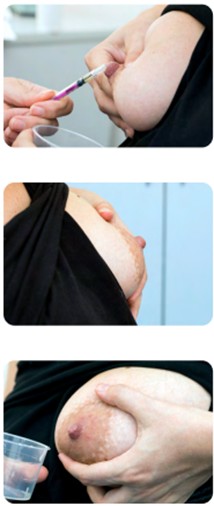
How to express colostrum
- Wash your hands with soap and water and dry well6.
- Gently massage your breast with warm hands to help colostrum to flow.
- Place your thumb and forefinger on either side of the areola, well back from the nipple1.
- Gently press the thumb and forefinger back into the breast tissue, compress the breast tissue, hold briefly and gently release1, 6.
- Repeat using a gentle rolling rhythm (like baby’s sucking)1.
- When you don’t notice any more colostrum flowing, rotate your hand position around the areola and repeat the process6.
- Collect colostrum drips into a syringe or clean cup6.
- Swap to the other breast after 2 or 3 minutes, or when the colostrum flow slows or stops4.
- Express each breast twice during each expression4. You can collect colostrum in the same syringe if you are only getting small amounts.
- Store the colostrum in the fridge in between sessions following the storage guide below.
- Once completed attach a label onto each syringe with your
- name
- date of birth
- medical record number (this will be on the front of your antenatal card)
- the date and time of expression
- Place syringe into a bag or container and place in the freezer – see storage recommendations below.
- Bring the frozen colostrum to hospital in a small Esky/cold bag with an ice brick when you come for the birth of your baby. Give to the midwife soon after arrival to store in a freezer until it is needed.
How to store colostrum safely
| Room Temperature (26°C or lower) | Refrigerator (5°C or lower) | Storage in freezer |
|---|---|---|
It is recommended to be stored in a fridge if possible. |
| Colostrum can be stored safely for:
|
If you have any questions or need further support, please ask your midwife during your next antenatal appointment. For all urgent concerns, please contact Maternity Assessment Unit at Centenary Hospital for Women and Children on (02) 5124 7444, or your midwife/doctor.
References
- Hand expressing [Internet]. Australian Breastfeeding Association: publisher unknown; 2023 [updated unknown; cited 2024 May 28] Available from: https://www.breastfeeding.asn.au/resources/hand-expressing
- Forster DA, Moorhead AM, Jacobs SE, Davis PG, Walker SP, McEgan, KM, Opie GF, Donath SM, Gold L, McNamara C, Aylward A, East C, Ford R, Amir LH. Advising women with diabetes in pregnancy to express breastmilk in late pregnancy (Diabetes and Antenatal Milk Expressing [DAME]): a multicentre, unblinded, randomised controlled trial. The Lancet. 2017 Jun 3;389(10085): 2204-2213.
- Tozier PK. Colostrum versus formula supplementation for glucose stabilisation in newborns of diabetic mothers. J Obstet Gynecol Neonatal Nurse. 2013 Nov-Dec;42(6):619-28.
- Antenatal expression of colostrum for vulnerable babies [Internet}. King Edward Memorial Hospital: publisher unknown; 2022 [cited 2024 May 28] Available from: https://www.kemh.health.wa.gov.au/~/media/HSPs/NMHS/Hospitals/WNHS/Documents/Patients-resources/Breastfeeding---antenatal-expression-of-colostrum-for-the-vulnerable-baby.pdf
- Antenatal expressing: expressing breastmilk during pregnancy [Internet]. Royal Women’s Hospital: publisher unknown. 2023 May. [updated unknown; cited 2024 May 28] Available from: https://thewomens.r.worldssl.net/images/uploads/fact-sheets/Antenatal-expressing-expressing-breastmilk-during-pregnancy%C2%AD230503.pdf
- Antenatal expression of colostrum - reasons for, when and how [Internet]. Pregnancy Birth& baby: publisher unknown; 2023 [updated 2023 June, cited 2024 May 28] Available from: https://www.pregnancybirthbaby.org.au/antenatal-expression-of-colostrum
- Caesarean birth [Internet]. The Royal Women’s Hospital Victoria Australia: unknown publisher; publisher unknown; date unknown [cited 2024 May 29]. Available from: https://www.thewomens.org.au/health-information/pregnancy-and-birth/labour-birth/caesarean-birth