
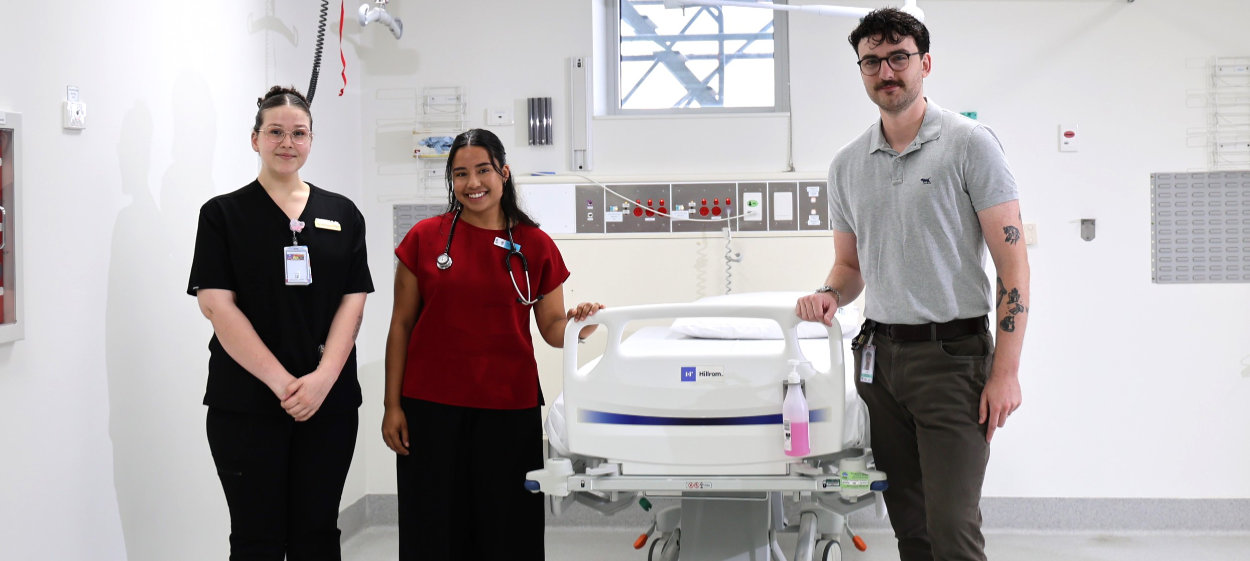
Graduates standing together in a clinical room, showcasing collaboration across disciplines in the hospital’s care team. From left to right: Isabella (Graduate Nurse), Olivia (Medical Intern) and Nate (Graduate Social Worker)
06 March 2026
Canberra Health Services (CHS) has welcomed 339 new public health graduates, including:
- 195 nurses
- 28 midwives
- 94 junior medical interns
- 22 allied health graduates
The graduates will gain exposure to a broad range of specialties and work rotations across Canberra Hospital, North Canberra Hospital, University of Canberra Hospital, mental health, justice health, outpatient clinics, community health centres and in rural NSW.
This year, three new graduates shared with us why they chose a career in health care and why they chose Canberra Health Services.
‘It was an easy decision to stay.’ Olivia, Medical Intern
Originally from Cairns in Far North Queensland, Olivia moved to Canberra seven years ago after receiving a scholarship to study at the Australian National University.
Canberra was a long way from home. But it felt right.
‘The city itself was actually a draw card for me. It is different to Cairns, but there are some similarities. I have really enjoyed my time here,’ said Olivia.
‘When it came time to decide where to begin my intern year, the choice was straightforward. I wanted to train somewhere I was familiar with. With people I am familiar with.’
She is realistic about the challenges of being a junior doctor. The work is demanding. The learning curve is steep. But she speaks strongly about the support structures in place.
‘Our training team has been fantastic. We have access to a clinical psychologist, which I think makes us quite unique. There is a big focus on speaking up, advocacy and having a voice as a junior doctor.’
‘It is a huge honour.’ Nate, Graduate Social Worker
Born in North Queensland and raised in Canberra, Nate describes himself as a ‘big fan of roundabouts and green boulevards’. Canberra is home.
He is now working in the Adult Mental Health Rehabilitation Unit at the University of Canberra Hospital, returning to the same ward where he completed his first placement.
‘I really loved my time there. The team were warm and welcoming,’ said Nate.
‘One in four Australians will experience mental ill health, but when you think about friends, family, colleagues, that number gets close to one hundred per cent.’
In rehabilitation, inpatient stays can be longer than in many hospital settings, often around a month or more. That time matters.
‘I get the opportunity to sit down with patients and really understand who they are, not as a caseload, but as individual people.’
‘Mental ill health affects long term outcomes and people’s ability to live their lives in a way that feels rewarding. It is a huge honour to support some of the most vulnerable members of our community.’
He also values the workplace culture.
‘Support extends beyond the clinical environment, from the Employee Assistance Program to practical benefits such as salary packaging and union membership through the CPSU.’
‘As someone who has very recently graduated, that kind of support makes a real difference.’
‘Caring is something I have always wanted to do.’ Isabella, Graduate Nurse
Isabella grew up in Moranbah, Queensland.
As a child, she broke ‘quite a few bones’, spending time in and out of hospital. The kindness of rural nurses stayed with her.
‘I wanted to give back for the care I received as a kid, especially in a rural place where staffing was limited.’
She studied through Central Queensland University, completing placements two hours from home. Now, she has moved to Canberra, drawn by the graduate program and the values of CHS.
‘I wanted to get out of my hometown and try something new. The vision here really aligned with me.’
‘We get constant check-ins. We can call on our Clinical Development Nurses on the ward. The support has been amazing.’
Isabella hopes to remain in paediatrics, where she has secured her first six-month rotation.
‘What excites me most is working across disciplines. I love an interdisciplinary team. Everyone brings a different perspective. It means we can deliver the best care possible.’
If you have a story you would like to share, get in touch.