
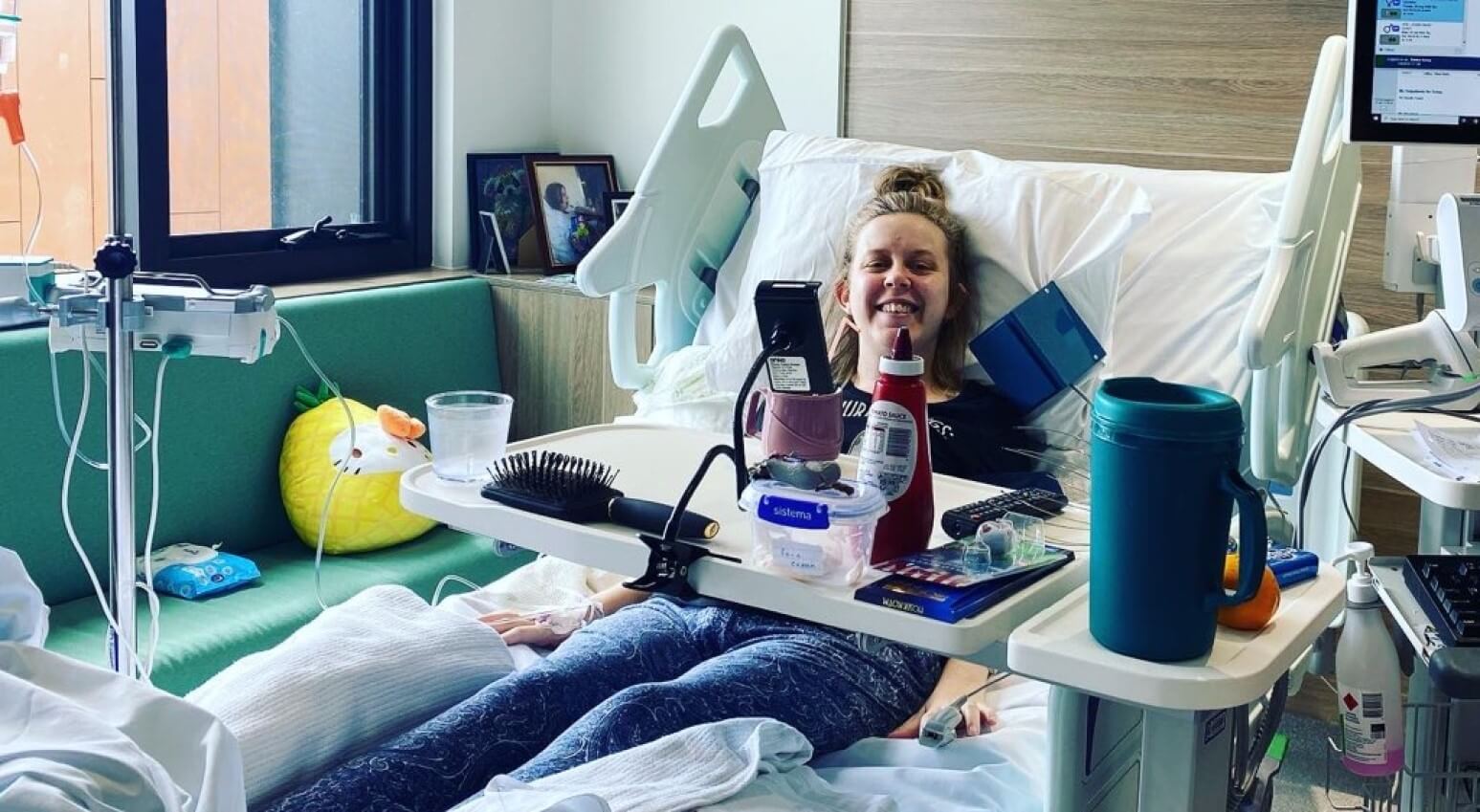
Michaela
28 February 2023
When Michaela turned 30, she wished for new experiences. But what she got that year wasn’t what she expected or hoped for.
After feeling exhausted one afternoon, she laid down for a nap while her husband took their 18 month old son for a walk. When she woke up, she couldn’t move her legs and could barely move her arms.
‘At first, I thought I was really tired. I managed to roll myself off the couch and called my husband, where I told him that something wasn’t quite right.’
When her husband returned home, he immediately called the ambulance which took Michaela to Canberra Hospital’s emergency department.
Upon initial inspection, the treating team thought Michaela had Grave’s Disease which is an immune system disorder that results in the overproduction of thyroid hormones.
‘I could feel them touching me, but I was paralysed. It was very confusing. I remember them saying that I shouldn’t be able to feel as I can’t move.’
A Professor was called in and asked Michaela if she had caught a virus lately.
‘I just stared at him and said “I’m a teacher and I catch everything. I couldn’t even tell you what I’ve caught previously”.’
‘That’s when he said he thought I had Guillain Barre Syndrome, a rare disorder in which your body's immune system attacks your nerves. I was quickly moved to the Neurology ward of the hospital and started treatment.’
Michaela was soon able to start walk again. But over the coming months, her condition would continue to get better and then deteriorate.
 ‘I was paralysed from the neck down for weeks. I couldn’t hug my son. I couldn’t do anything but lie there. Although, I was still able to talk and run my mouth and annoy everyone.’
Michaela spent most of her stay in the University of Canberra Hospital, our specialist rehabilitation facility. During her stay, Michaela had a nerve conduction study which found she had Chronic Inflammatory Demyelinating Polyneuropathy (CIDP). This is a rare neurological disorder that results in slowly progressive weakness and loss of feeling in the legs and arms. It affects 2 in every 100,000 people.
Within a few days of starting treatment for CIDP, she was able to move her arms and the nurses helped her to bake a cake for her son’s birthday with the support of occupational therapists.
After 222 days, Michaela was able to walk out of hospital. Since going home, she’s returned to teaching and signed up to do Karate at the same school as her son, and absolutely loves it.
‘I think it would shock a few staff who treated me as I was completely paralysed and in a wheelchair. Especially, now that I’m up and doing pretty much everything I used to do – but with a little extra effort.’
‘There’s no way to describe how amazing and involved all the staff who treated me at both hospitals were. Even if I couldn’t always have my family there due to COVID, the staff became like family to me.’
If you have a story you would like to share, get in touch.