
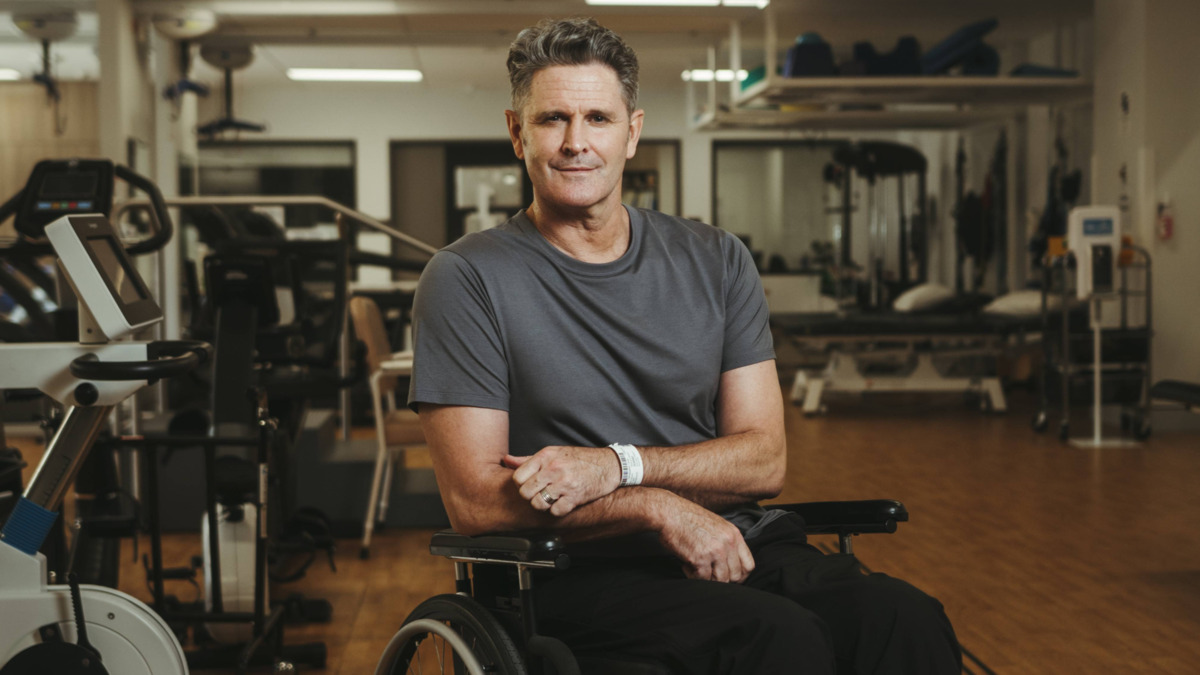
‘It's about small gains. That would be my only message to people going through it. Don't look at it result-wise, just get up daily and go to work.’
19 April 2022
Chris Cairns’ life took a turn for the worse in August last year when he suffered two medical emergencies. The health battle for the former New Zealand cricket player, who was one of the game’s best all-rounders, began with a ‘feeling of fogginess’.
‘I had a bit of a lie down when I got home from dropping the kids off at school... I then tried to get up from the bed and go to the bathroom and collapsed.’
Chris was then rushed to the Emergency Department at Canberra Hospital, accompanied by his wife Mel.
‘[The Emergency Department nurses] came over, took my blood pressure, and it was through the floor, so they rushed me straight through to a resus area. That was the last of my memory for nine days.’
Mel remembers that day a lot more vividly.
‘Within about ten minutes after the CT scan, they came out and said he needs to go to theatre right now.’
‘The first surgery was seven hours. The anaesthetist explained to us that it looked like a grenade had gone off in his chest. Over the next 24 to 48 hours things progressively got worse.’
Chris was then flown up to Sydney’s St Vincent’s Hospital in a critical state. Over the next two weeks he had multiple procedures to improve his condition. After finally regaining consciousness, Chris couldn’t move his legs.
‘The next day I had an MRI scan and that showed a spinal stroke.’
Chris eventually returned to Canberra and began the rehabilitation process at the University of Canberra Hospital (UCH).
‘The care has been all encompassing. I have been supported by nurses, doctors, physios and occupational therapists.’
‘It is great a facility like UCH exists in Canberra as it meant that I didn’t have to stay in Sydney for rehabilitation. The team here have been great with setting goals for my recovery.’
Chris is slowly learning to use his legs again thanks to the robotic exoskeleton he has been using at UCH.
The Keeogo equipment, which was lent to Chris to trial, provides the support that he needs to relearn his natural leg movement. It can be adjusted to suit his strength and muscle memory.
‘It was strange. I had to learn to walk again, and I still don't know if I'll be able to do it because I have to get my muscles back,’ Chris said.
‘The fact that I can be upright and start the process to see if I can do it, that's the best thing. It's hope. That's what it gives you and you have a purpose.’
Chris hopes that by sharing his journey, particularly by being a trailblazer of the exoskeleton therapy, it will give others in a similar situation hope.
‘It's about small gains. That would be my only message to people going through it. Don't look at it result-wise, just get up daily and go to work.’
Over the past 18 months, UCH has been looking into establishing and developing a robotics lab.
Robotic rehabilitation technology has the potential to completely change the way that allied health professionals deliver treatment to patients, as can be seen through Chris’ journey.
Sadly, Chris was also diagnosed with bowel cancer last month.
‘I have to be honest, sometimes I don't know the body I'm in, I'm still coming to terms with it. But you have to keep finding a purpose.’
If you have a story you would like to share, get in touch.